Skip to content

[email protected] | About Us | Privacy Policy | Terms Of Use

Facebook Pinterest
logo
  • Home ImprovementExpand
    • Deck
    • Barn Doors
    • Patio
    • Bathroom
    • Garden Beds
    • Winter Home Prep
  • Mobile HomeExpand
    • Crawl Space
    • Skirting
  • BackyardExpand
    • Landscaping
    • Curb Appeal
    • Water Features
  • Porch
  • Garden
  • Contact
logo
Garden

How to Grow Sunflowers in Containers: The Trick That Makes Them Explode All Summer

You want big, bold sunflowers on your patio or balcony, but you’re not sure if containers can actually pull it off. Good news — they absolutely can, and with the right setup, your potted sunflowers can bloom non-stop from early summer straight through fall.

This guide is for you if you’re a beginner gardener, an apartment dweller with limited outdoor space, or someone who’s tried growing sunflowers in containers before and ended up with scraggly, short-lived plants.

Here’s what you’ll walk away knowing: how to choose the right sunflower variety for container growing, which soil mix and feeding routine actually drives explosive blooms, and how to keep your plants healthy so the flowers just keep coming all season long.

No filler, no complicated techniques — just what works.

Contents

Toggle
    • You Might Also Love These Ideas
      • How to Restore Your Old Garden Bench: Complete 2025 Guide
      • How to Make Cattle Panel Arches for the Garden: A…
      • 12 Stunning Front Yard Vegetable Gardens to Boost Curb Appeal…
  • Choose the Right Sunflower Variety for Container Success
      • Compact Dwarf Varieties That Thrive in Small Spaces
      • Multi-Branching Types That Bloom All Season Long
      • Avoid These Common Varieties That Struggle in Pots
  • Pick the Perfect Container to Set Your Sunflowers Up for Success
      • Ideal Pot Size for Strong Root Development
      • Best Materials That Regulate Temperature and Moisture
      • Why Drainage Holes Are Non-Negotiable
      • Smart Container Placement for Maximum Sun Exposure
  • Master the Soil Mix That Fuels Non-Stop Growth
      • The Ideal Soil Blend for Nutrient-Rich Container Gardening
      • Amendments That Boost Drainage and Aeration
      • Why Garden Soil Alone Will Slow Your Plants Down
  • Plant and Germinate Like a Pro for Faster Results
      • The Best Time to Plant Seeds for a Long Blooming Season
      • Correct Planting Depth That Speeds Up Germination
      • Thinning Seedlings to Maximize Each Plant’s Potential
      • How to Transplant Without Shocking Your Seedlings
      • Direct Sow vs. Starting Indoors for Container Growing
      • You Might Also Like!

You Might Also Love These Ideas

10 Stunning DIY Garden Archway Ideas

10 Stunning DIY Garden Archway Ideas to Transform Your Curb…

DIY Puppy Lawn Using Hydroponics Or Real Grass Systems

garden ideas

12 Stunning Garden Ideas to Transform Your Outdoor Space on…

Choose the Right Sunflower Variety for Container Success

Aspect ratio 3:2, full-bleed clean professional infographic illustration about container sunflowers. Wide horizontal layout with three main color-block sections across the canvas, using bright sunflower yellow, warm green, soft cream, and muted orange accents. Bold top heading in large modern sans-serif font: “Choose the Right Sunflower Variety for Container Success”. Smaller subtitle below: “Compact dwarf varieties that thrive in small spaces”.Left section with a potted sunflower icon and a checkmark badge, titled: “Compact Dwarf Varieties That Thrive in Small Spaces”. Include a neat comparison table with three rows and three columns labeled “Variety”, “Height”, and “Bloom Color”. Text in table:“Sundance Kid” | “18–24 in” | “Yellow/Red”“Little Becka” | “12–18 in” | “Bi-color”“Elf” | “16 in” | “Bright Yellow”Add small illustrated container flower pots beside each row, showing compact sunflower plants under 24 inches tall.Center section with a looping bloom/calendar icon and branching sunflower illustration, titled: “Multi-Branching Types That Bloom All Season Long”. Add a horizontal timeline band labeled “June” “July” “August” “September” with multiple blooming flowers לאורך the timeline. Include short text in two highlighted callout boxes:“‘Strawberry Blonde’”“‘Autumn Beauty’”Add a small deadheading scissors icon and a caption line: “Continuous color from June through September”. Show branching stems with repeated blooms.Right section with a warning icon and large tall sunflower illustration crossed out, titled: “Avoid These Common Varieties That Struggle in Pots”. Include two stacked caution cards with bold names and short notes:“‘Mammoth’” — “10+ feet tall”“‘Russian Giant’” — “10+ feet tall”Add smaller text below: “Need deep ground roots” and “Pot size can’t support their root mass or weight”. Show a tipped-over oversized pot and a root ball crowding a container, with a red no symbol over the plants.Use clear visual hierarchy, bold section headers, simple icon markers, and wide spacing. Keep all text crisp and readable, aligned in organized blocks across the horizontal layout.

Compact Dwarf Varieties That Thrive in Small Spaces

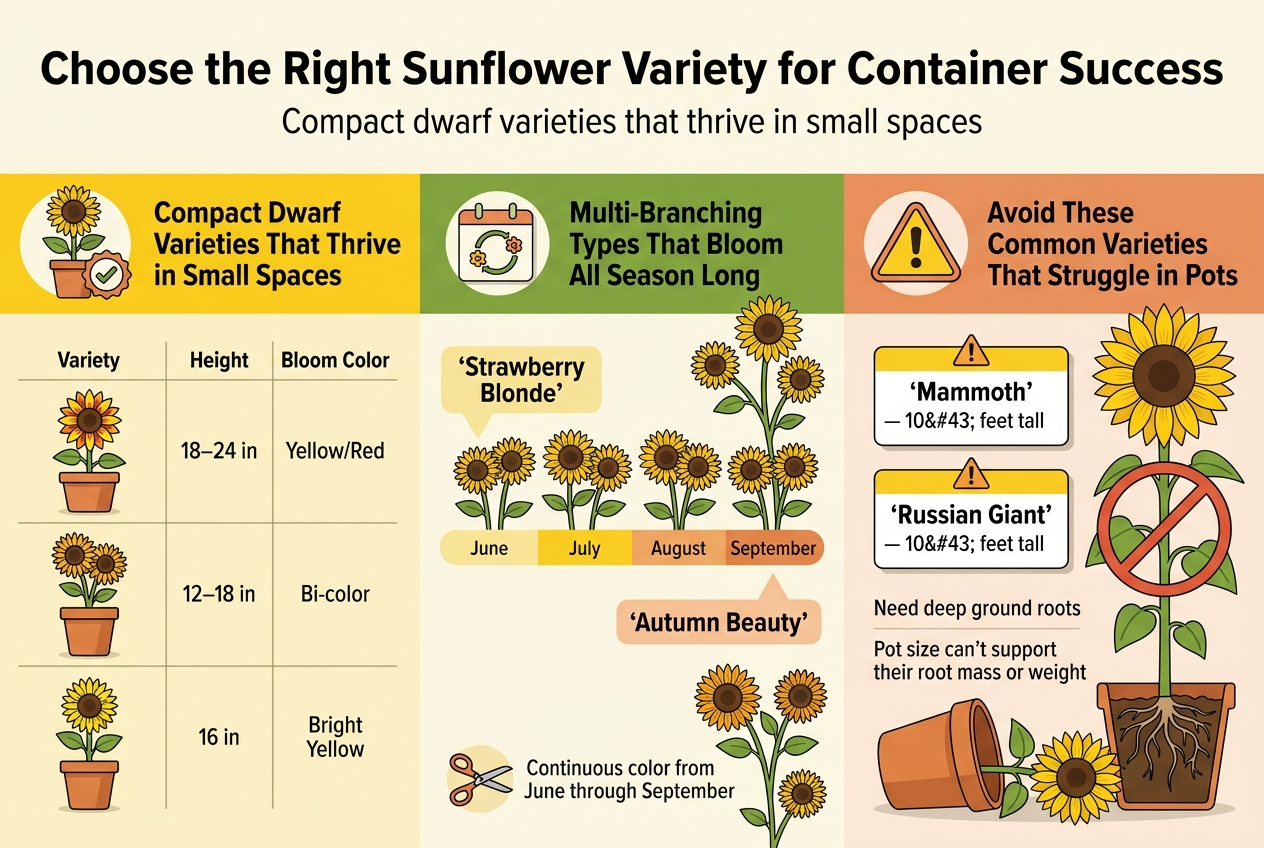
Your best bets for containers are dwarf varieties that stay under 24 inches tall. ‘Sundance Kid’, ‘Little Becka’, and ‘Elf’ are compact powerhouses that won’t tip over your pots or shade out everything around them. Their shorter root systems adapt well to confined spaces, and you’ll still get those gorgeous, full blooms.

Also Read  Easy Guide to Creating a Small Backyard Garden: The Complete Step-by-Step Guide
VarietyHeightBloom Color
Sundance Kid18–24 inYellow/Red
Little Becka12–18 inBi-color
Elf16 inBright Yellow

Multi-Branching Types That Bloom All Season Long

If you want continuous color from June through September, go with branching varieties like ‘Strawberry Blonde’ or ‘Autumn Beauty’. Unlike single-stem types that bloom once and quit, these keep pushing out new flowers the more you deadhead them. You’ll get weeks of blooms instead of just one big show that disappears fast.


Avoid These Common Varieties That Struggle in Pots

Skip ‘Mammoth’ and ‘Russian Giant’ — they need deep ground roots and grow 10+ feet tall, making them totally wrong for container life. Your pot simply can’t support their root mass or weight. Stick to varieties bred for smaller spaces, and you’ll avoid the frustration of stunted, floppy, or root-bound plants that never really thrive.

Pick the Perfect Container to Set Your Sunflowers Up for Success
Create a clean, modern infographic in a 3:2 landscape aspect ratio, full-bleed edge-to-edge, with a bright gardening theme in sunflower yellow, leaf green, terracotta orange, sky blue, and warm neutral beige. Use bold sans-serif typography with strong hierarchy, crisp icons, and a professional editorial layout.Top header across the full width:Large bold title in dark green: "Pick the Perfect Container to Set Your Sunflowers Up for Success"Place a sunflower icon beside the title and a subtle background pattern of leaves and sun rays.Below the header, arrange four wide horizontal sections in a balanced two-column grid or stacked wide blocks, not a narrow centered column.Section 1 on the left with a pot icon:Heading: "Ideal Pot Size for Strong Root Development"Include a simple side-view container illustration with a ruler marker.Text bullets:"12–16 inches deep and wide for dwarf varieties""18–24 inches for taller types""Cramped pots stunt growth and create weak, floppy stems"Section 2 on the right with four material icons and a comparison table layout:Heading: "Best Materials That Regulate Temperature and Moisture"Create a neat 4-row comparison block with three labeled columns: "Container Material", "Pros", "Cons"Rows:"Terracotta" — "Breathable, regulates moisture" — "Dries out quickly in heat""Fabric Grow Bags" — "Excellent airflow, prevents root circling" — "Needs more frequent watering""Plastic" — "Retains moisture longer, lightweight" — "Can overheat in direct sun""Wood" — "Good insulation, natural look" — "Can rot over time"Add small material icons for each row: clay pot, fabric bag, plastic pot, wooden planter.Section 3 across the full width with a drainage icon:Heading: "Why Drainage Holes Are Non-Negotiable"Show a pot bottom with 2–3 visible drainage holes and water droplets draining out.Text bullets:"Sunflowers hate sitting in soggy soil""Root rot can kill the plant""Make sure your container has at least two to three drainage holes""If your pot doesn't have them, drill your own before planting"Section 4 across the full width with sun and patio icons:Heading: "Smart Container Placement for Maximum Sun Exposure"Show a south-facing patio, balcony, or porch scene with a movable container and sun path arrows.Text bullets:"6 to 8 hours of direct sunlight daily""Place containers on a south-facing patio, balcony, or porch""Move pots to chase the sun as the season shifts"Use clear section dividers, checkmark and warning symbols, and small arrows for guidance. Keep text fully readable, left-aligned within each section, with strong contrast and ample spacing.

Ideal Pot Size for Strong Root Development

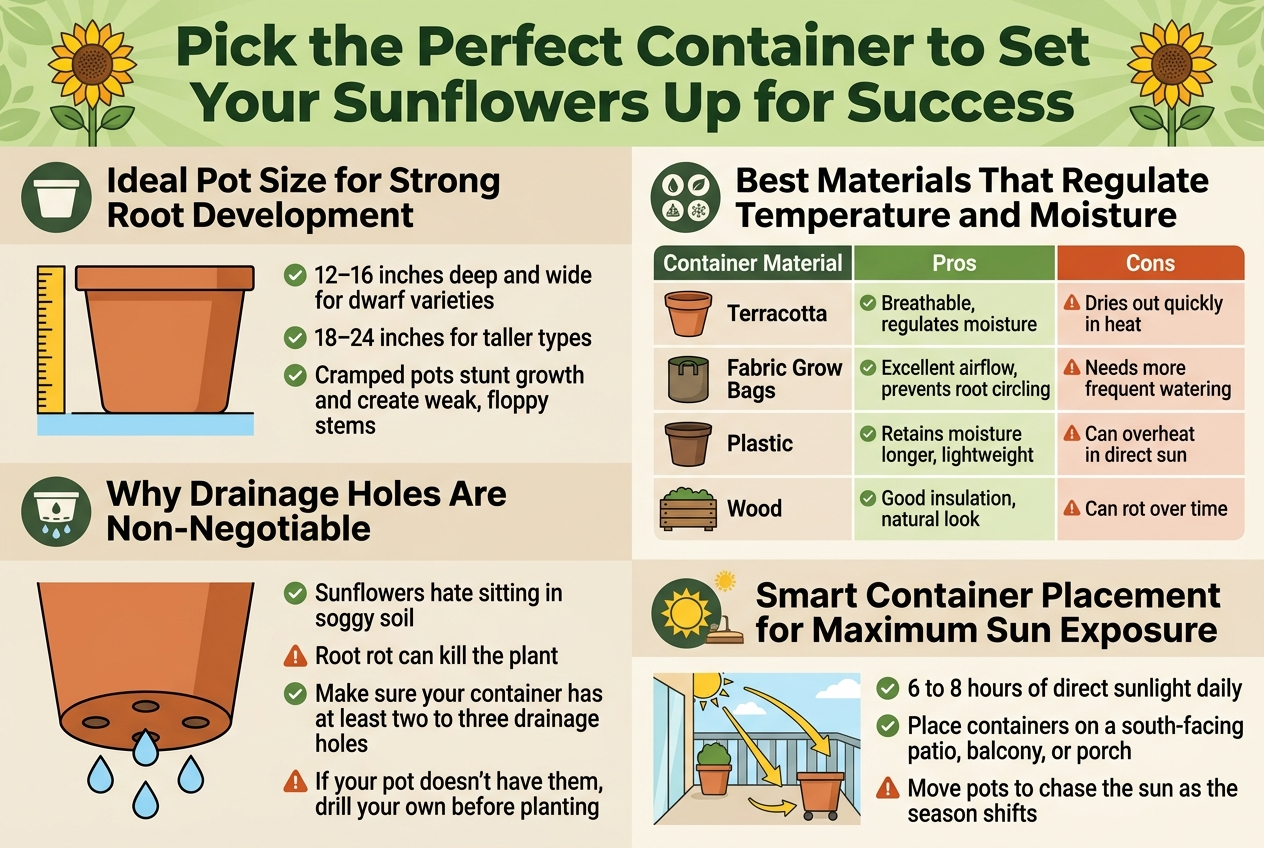
Your sunflowers need room to stretch their roots, so go with a container that’s at least 12–16 inches deep and wide for dwarf varieties, and 18–24 inches for taller types. A cramped pot stunts growth and leads to weak, floppy stems that struggle to support blooms.

Best Materials That Regulate Temperature and Moisture

Container MaterialProsCons
TerracottaBreathable, regulates moistureDries out quickly in heat
Fabric Grow BagsExcellent airflow, prevents root circlingNeeds more frequent watering
PlasticRetains moisture longer, lightweightCan overheat in direct sun
WoodGood insulation, natural lookCan rot over time

Your best pick depends on your climate. In hot, dry areas, plastic or wood keeps roots from drying out too fast. In humid regions, fabric grow bags give you that extra airflow your plants will love.

Also Read  12 Stunning Garden Planter Ideas to Transform Your Outdoor Space

Why Drainage Holes Are Non-Negotiable

Sunflowers hate sitting in soggy soil — it’s the fastest way to kill your plant through root rot. Make sure your container has at least two to three drainage holes at the bottom. If your pot doesn’t have them, grab a drill and make your own before you plant anything.

Smart Container Placement for Maximum Sun Exposure

Your sunflowers need a minimum of six to eight hours of direct sunlight daily. Place your containers on a south-facing patio, balcony, or porch where they get the strongest light. One big advantage of growing in containers is that you can easily move them to chase the sun as the season shifts.

Master the Soil Mix That Fuels Non-Stop Growth
Create a clean, modern gardening infographic in a 3:2 aspect ratio, full-bleed layout with no poster frame, using a wide horizontal composition and balanced multi-section blocks. Style: bright natural greens, earthy browns, soft cream background, accents of sky blue and warm yellow. Use bold sans-serif typography for headings and readable sans-serif body text. Top across the full width: large bold title in dark green, “Master the Soil Mix That Fuels Non-Stop Growth”. Directly below it, smaller subtitle in warm brown, “The Ideal Soil Blend for Nutrient-Rich Container Gardening”.Left-center large section: a circular pie-chart style soil mix graphic with three labeled slices and matching color-coded labels beside it. Include exact labels: “60% Potting Mix”, “30% Compost”, “10% Perlite”. Add small icons next to each label: a bag of soil, a compost heap with leaves, and white perlite granules. Caption under the chart: “The Ideal Blend”.Right-center section: a clean 3-row comparison table with a header row. Title above the table: “Amendments That Boost Drainage and Aeration”. Table columns exactly labeled “Amendment”, “Benefit”, and “How Much to Add”. Rows exactly labeled:“Perlite” | “Improves drainage and airflow” | “10–15% of total mix”“Coarse sand” | “Prevents compaction” | “Small handful per pot”“Worm castings” | “Slow-release nutrients” | “Up to 20% of mix”Add a small icon to the left of each row: white porous stones for perlite, tan sand grains for coarse sand, and a red wiggler worm on dark compost for worm castings.Bottom wide section spanning the full width: a split comparison banner with two side-by-side panels. Left panel shows compacted garden soil in a container with a wilted sunflower and a red warning symbol. Add bold heading: “Garden Soil Alone”. Add short text: “Compacts quickly in containers”, “Cuts off oxygen to roots”, “Traps excess moisture”, “Stunted, stressed, barely blooming”. Right panel shows a healthy container with loose potting mix, visible roots, drainage, and a tall blooming sunflower. Add bold heading: “Proper Potting Mix”. Add short text: “Loose, airy, and well-draining”, “Roots can breathe”, “Supports blooms all summer”. Include a clear arrow or swap symbol between the two panels indicating replacement.Use small checkmark icons for the recommended mix sections and a warning triangle icon for the garden soil warning section. Keep all text sharp, high-contrast, and easy to read. Arrange elements in wide blocks, not a centered vertical stack. Ensure the infographic feels professional, educational, and visually appealing with subtle texture and clean spacing.

The Ideal Soil Blend for Nutrient-Rich Container Gardening

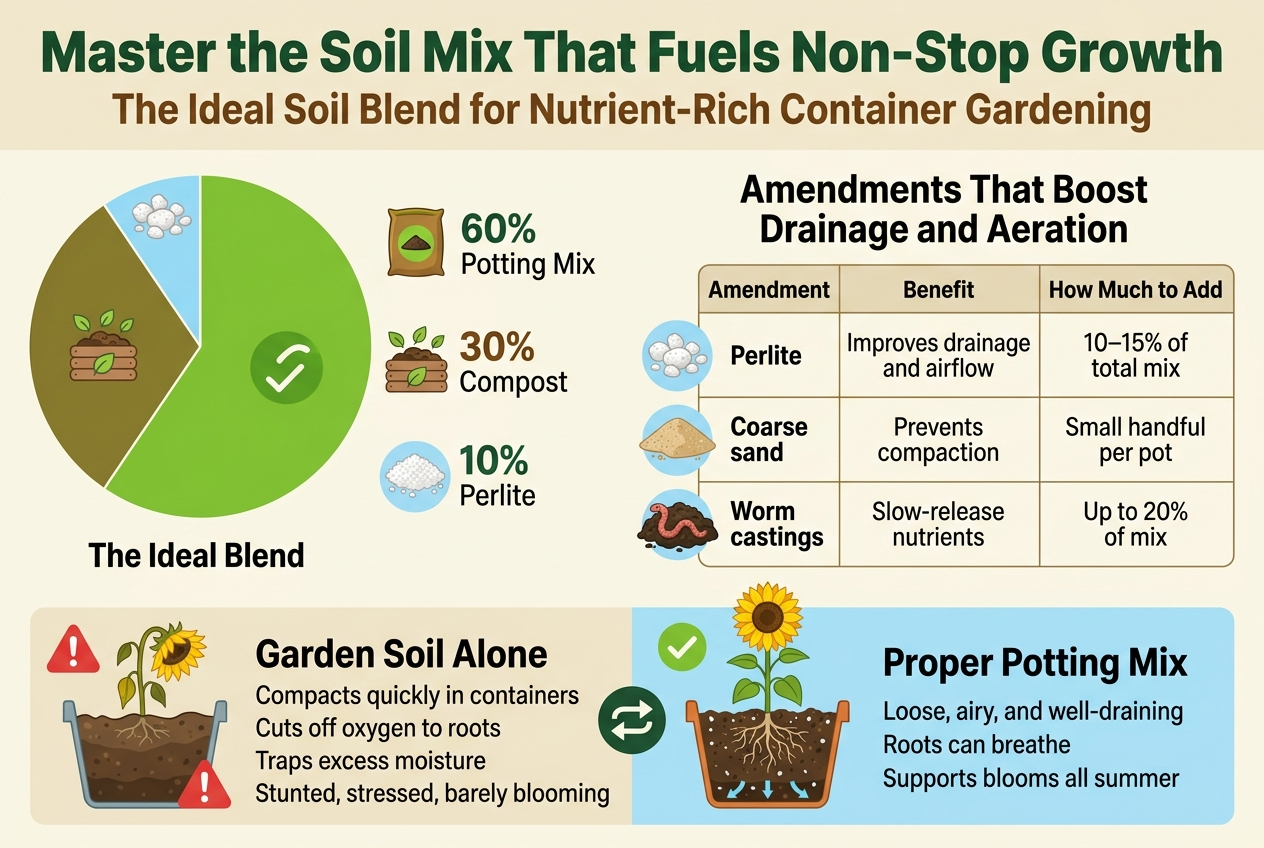
Your sunflowers thrive when you give them a mix of high-quality potting soil, compost, and a handful of perlite. Aim for roughly 60% potting mix, 30% compost, and 10% perlite — this combo gives your plants the nutrients, moisture retention, and breathing room they desperately need to push out blooms all summer long.

Amendments That Boost Drainage and Aeration

AmendmentBenefitHow Much to Add
PerliteImproves drainage and airflow10–15% of total mix
Coarse sandPrevents compactionSmall handful per pot
Worm castingsSlow-release nutrientsUp to 20% of mix

Mixing in perlite or coarse sand keeps your soil loose so roots can breathe and water flows freely — because waterlogged roots are a fast track to dead plants.

Why Garden Soil Alone Will Slow Your Plants Down

Garden soil compacts quickly inside containers, cutting off oxygen to your roots and trapping excess moisture. Your sunflowers end up stunted, stressed, and barely blooming. Swap it out for a proper potting mix every single time.

Also Read  How to Start Chaos Gardening with This Easy Guide: Real Methods That Actually Work

Plant and Germinate Like a Pro for Faster Results
Create a clean, professional full-bleed infographic in a 3:2 horizontal aspect ratio with a bright gardening theme, using greens, sunny yellows, warm خاک/soil browns, and white backgrounds with subtle texture. Use modern sans-serif fonts with a bold title at the top and clear visual hierarchy. Top header across the full width:Bold title text: "Plant and Germinate Like a Pro for Faster Results"Add a small sunflower sprout illustration beside the title.Main layout: five wide horizontal sections or a two-column upper section plus three lower blocks, organized neatly with icons and short text.Section 1 at upper left:Heading: "1. Best Time to Plant Seeds"Use a calendar icon and thermometer icon.Text: "Start after last frost"Text: "Soil temperature: 55–60°F"Text: "Stagger plantings every 2–3 weeks"Add a simple timeline strip showing repeated planting dates.Section 2 at upper right:Heading: "2. Correct Planting Depth"Use a seed in soil icon with a ruler mark.Text: "Plant seeds about 1 inch deep"Text: "Germination in 7–10 days"Text: "Too deep slows sprouting"Show a cross-section diagram of soil with a seed placed at the correct depth.Section 3 centered lower left:Heading: "3. Thin Seedlings"Use a scissors icon and two seedling icons.Text: "Thin when seedlings reach 3 inches tall"Text: "Keep only the strongest one per container"Text: "Snip weaker seedlings at soil level"Show one healthy sunflower seedling standing taller while smaller seedlings are crossed out.Section 4 centered lower right:Heading: "4. Transplant Without Shock"Use a cloud icon, watering can icon, and potted seedling icon.Text: "Move on a cloudy day or in the evening"Text: "Water well 1 hour before transplanting"Text: "Match hole depth to root depth"Text: "Firm soil and water immediately"Show a small step-by-step transplant sequence with arrows.Bottom wide comparison block spanning the full width:Heading: "5. Direct Sow vs. Starting Indoors"Use a split two-column comparison table with bold labels and simple icons.Left column title: "Direct Sow"Text: "Less transplant stress"Text: "Simple and fast"Text: "Weather-dependent"Text: "Slower start"Right column title: "Starting Indoors"Text: "Head start on the season"Text: "Controlled conditions"Text: "Risk of transplant shock"Text: "Extra work"Add a small note below the table:"Direct sow is easiest for containers. Start indoors in short seasons, then move seedlings early."Use clean dividers, rounded cards, and small checkmark and warning symbols for emphasis. Keep all text large, readable, and evenly spaced, with sunflower and seedling imagery integrated throughout. No decorative frame, no narrow vertical poster layout, no clutter.

The Best Time to Plant Seeds for a Long Blooming Season

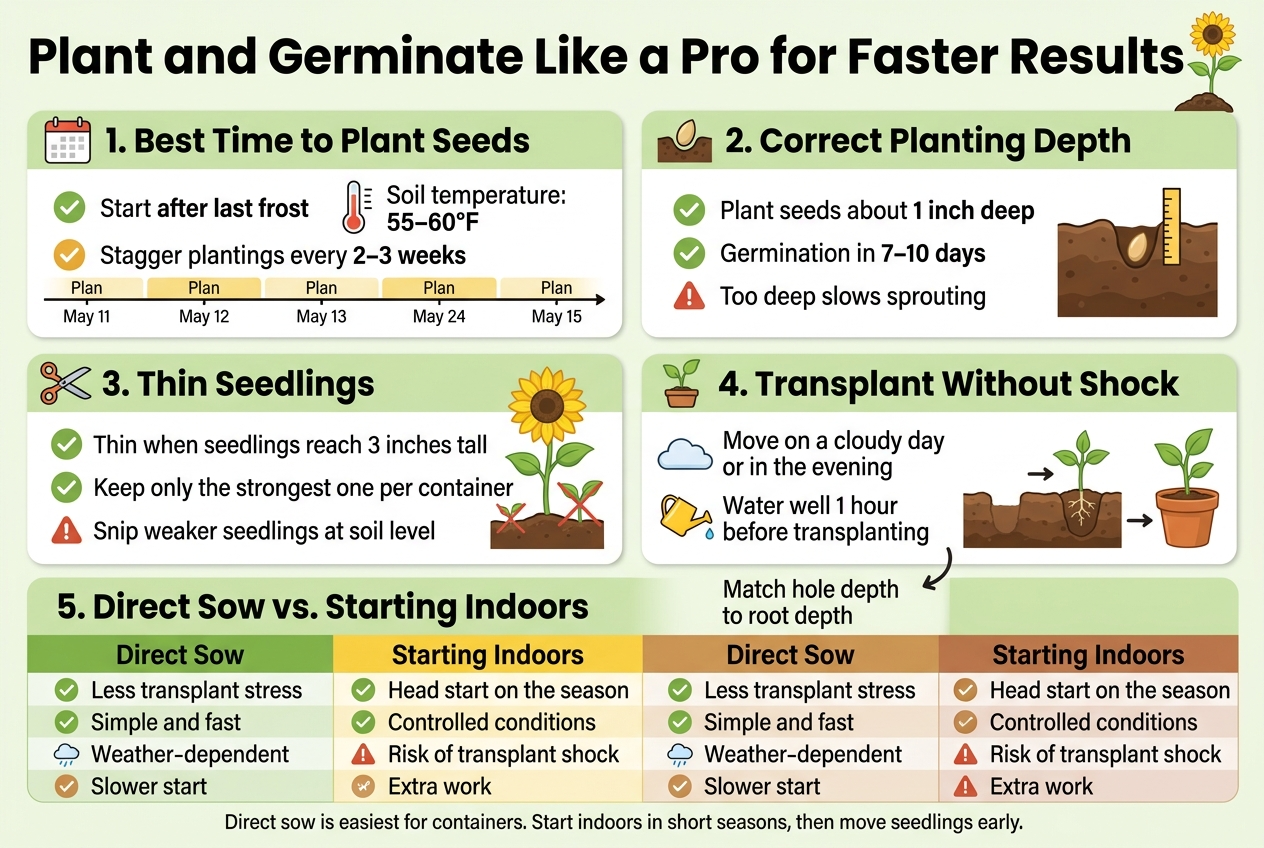
Timing your planting right makes a huge difference in how long your container sunflowers bloom. You want to start after your last frost date, when soil temps hit around 55–60°F. If you stagger your plantings every two to three weeks, you keep fresh blooms popping up all summer long instead of one big burst that fades fast.

Correct Planting Depth That Speeds Up Germination

Push your seeds about one inch deep into the soil — not too shallow, not too deep. When you plant at the right depth, your seeds stay moist and warm enough to crack open quickly, usually within seven to ten days. Going too deep starves them of the warmth they need, which slows everything down and frustrates you before you even get started.

Thinning Seedlings to Maximize Each Plant’s Potential

Once your seedlings hit about three inches tall, keep only the strongest one per container. You might feel bad snipping the extras, but leaving multiple plants crammed together means they compete for water, nutrients, and root space — and everyone loses. Snip the weaker ones at soil level rather than pulling them out so you don’t disturb your winner’s roots.

How to Transplant Without Shocking Your Seedlings

If you started seeds in small pots or trays, move them on a cloudy day or in the evening to avoid direct sun stress. Water your seedlings well an hour before transplanting so the root ball holds together. Dig a hole in your container that matches the root depth, lower your seedling in gently, firm the soil around it, and give it a good drink right away.

Direct Sow vs. Starting Indoors for Container Growing

MethodProsCons
Direct SowLess transplant stress, simple, fastWeather-dependent, slower start
Starting IndoorsHead start on the season, controlled conditionsRisk of transplant shock, extra work

For containers, direct sowing is your easiest bet because sunflowers hate having their roots messed with. Starting indoors works great if your growing season is short — just move your seedlings to their final container early before the roots get too cozy in the starter pot.

You Might Also Like!

  • 10 Easy Flowers to Grow in Containers That Bloom All Summer — Stunning Tips & Foolproof Pairings
  • How to Grow Cosmos in Containers the Right Way — Beginner-Proof Step-by-Step
  • How to Grow Cosmos in Containers
    How to Grow Cosmos in Containers: A Step-by-Step Guide That Actually Works
Rafay Khan

Post navigation

Previous Previous
10 Under Deck Ideas That Turn Wasted Space Into Outdoor Living Rooms: Stunning DIY Transformations & Budget Hacks
NextContinue
10 Easy Flowers to Grow in Containers That Bloom All Summer — Stunning Tips & Foolproof Pairings

You Might Also Like!

  • 10 Easy Flowers to Grow in Containers That Bloom All Summer — Stunning Tips & Foolproof Pairings
  • How to Grow Cosmos in Containers the Right Way — Beginner-Proof Step-by-Step
  • How to Grow Cosmos in Containers
    How to Grow Cosmos in Containers: A Step-by-Step Guide That Actually Works

Search More!

About DearWorld

We share practical DIY tips, budget-friendly ideas, and creative inspiration for mobile homes, backyards, patios, porches, gardens, and skirting. Helping you make every space feel like home — one project at a time.

  • About Us
  • Privacy Policy
  • Terms & Conditions
  • Blog

© 2026 Dear World - WordPress Theme by Kadence WP

Facebook Instagram Pinterest
Scroll to top
  • Home Improvement
    • Deck
    • Barn Doors
    • Patio
    • Bathroom
    • Garden Beds
    • Winter Home Prep
  • Mobile Home
    • Crawl Space
    • Skirting
  • Backyard
    • Landscaping
    • Curb Appeal
    • Water Features
  • Porch
  • Garden
  • Contact
Search