Skip to content

[email protected] | About Us |ย Privacy Policy | Terms Of Use

Facebook Pinterest
logo
  • Home ImprovementExpand
    • Deck
    • Barn Doors
    • Patio
    • Bathroom
    • Garden Beds
    • Winter Home Prep
  • Mobile HomeExpand
    • Crawl Space
    • Skirting
  • BackyardExpand
    • Landscaping
    • Curb Appeal
    • Water Features
  • Porch
  • Garden
  • Contact
logo
Deck

Build a Deck Railing for Under $300 That Looks Custom-Built

You don’t need to spend thousands of dollars to get a deck railing that looks like a pro installed it. If you’re a DIY homeowner who wants a sharp, sturdy railing without blowing your weekend budget, this guide is for you.

Here’s what you’ll walk away with: a clear plan for designing a railing that looks intentional and polished, a straightforward breakdown of the best budget-friendly materials that don’t look cheap, and a step-by-step build process that takes the guesswork out of getting a professional finish.

Building a custom deck railing for under $300 is completely doable โ€” you just need to know where to put your money and where to save it.

Contents

Toggle
  • Plan Your Railing Design to Maximize Style on a Budget
    • You Might Also Love These Ideas
      • 10 Under Deck Storage Ideas to Maximize Space and Organization
      • Covered vs. Open Decks for Mobile Homes: Pros & Cons…
      • 10 DIY Deck Ideas Under $1,000 That Look Like Professional…
      • Choose a Design Style That Looks Expensive but Costs Little
      • Measure Your Deck Space Accurately to Avoid Costly Mistakes
      • Sketch a Simple Layout to Guide Your Build
  • Select the Right Materials Without Overspending
      • Compare Wood, Metal, and Composite Options for Value
      • Buy in Bulk to Cut Down on Per-Unit Costs
      • Source Discounted Materials From Local Suppliers and Salvage Stores
      • Pick Hardware That Adds a Premium Look for Less
  • Gather the Tools You Need Before You Start
      • A. Identify the Essential Tools for a Smooth Build
      • B. Rent Specialty Tools Instead of Buying Them
  • Build the Railing Step by Step for a Professional Finish
      • Install Posts Securely to Ensure Safety and Stability
      • Cut and Attach Rails at the Right Height for Code Compliance
      • Add Balusters Evenly for a Clean and Polished Appearance
      • Secure All Connections to Prevent Wobbling and Wear
      • Sand and Smooth All Surfaces for a Refined Look
      • You Might Also Like!

Plan Your Railing Design to Maximize Style on a Budget

Create a clean, professional full-bleed infographic in a 3:2 landscape aspect ratio about deck railing planning on a budget. Use a modern flat design with a light warm background, navy and teal accents, orange highlights, crisp sans-serif fonts, and strong visual hierarchy. Place a bold headline across the top:"Plan Your Railing Design to Maximize Style on a Budget"Below the headline, organize the content into three wide horizontal sections or three side-by-side feature blocks across the page, each with a numbered badge, a simple icon, a subheading, and short supporting text.Section 1 on the left: include a stylish railing icon showing horizontal rails, vertical balusters, and cable lines as small visual examples. Add the subheading:"1. Choose a Design Style That Looks Expensive but Costs Little"Add short text beneath:"Simple horizontal rails, classic vertical balusters, or cable-style looks can give your deck a high-end feel."Section 2 in the center: include a tape measure icon and a deck outline with measurement arrows around the perimeter. Add the subheading:"2. Measure Your Deck Space Accurately to Avoid Costly Mistakes"Add short text beneath:"Record all dimensions, total linear footage, height requirements, and corners or angles before buying materials."Section 3 on the right: include a pencil and graph paper icon with a simple deck sketch, post markers, and spacing dots. Add the subheading:"3. Sketch a Simple Layout to Guide Your Build"Add short text beneath:"Draw your deck shape, mark post placements every 6โ€“8 feet, and map out baluster spacing."Use small callout labels near the visual elements:"36โ€“42 inches""6โ€“8 feet""Linear footage""Post placements"Add subtle connecting arrows or lines between the three sections to suggest a planning flow from style to measuring to sketching. Keep the layout balanced, spacious, and easy to read, with no centered vertical stack. Include clean iconography, neat section dividers, and a polished infographic style.

You Might Also Love These Ideas

How to Cover the Sides of Your Raised Deck

How to Cover the Sides of Your Raised Deck (Without…

10 Under Deck Ideas That Turn Wasted Space Into Outdoor…

12 Stunning Deck Stair Ideas That Transform Your Outdoor Space…

Choose a Design Style That Looks Expensive but Costs Little

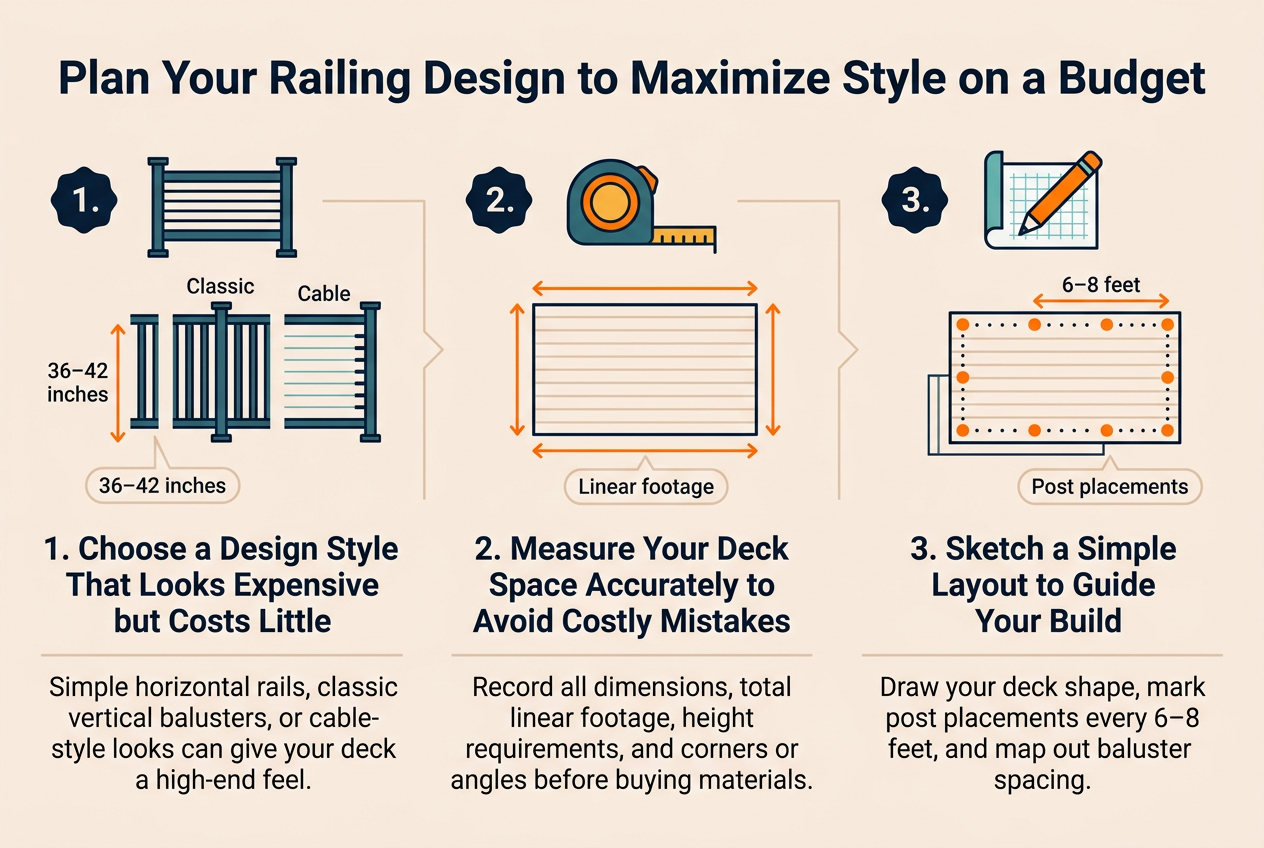
Your railing doesn’t need to cost a fortune to look stunning. Simple horizontal rail designs, classic vertical balusters, or even a cable-style look using affordable materials can give your deck a high-end feel. Pick a style that complements your home’s exterior, and you’re already ahead of the game.

Also Read  Skirting Options for Mobile Home Decks in 2025

Measure Your Deck Space Accurately to Avoid Costly Mistakes

Before buying a single board, grab your tape measure and record every dimension of your deck perimeter carefully. Note the total linear footage, the height requirement (typically 36โ€“42 inches depending on your local code), and any corners or angles. Double-checking your numbers now saves you from wasting money on materials later.

Sketch a Simple Layout to Guide Your Build

You don’t need fancy software โ€” a pencil and graph paper work perfectly. Draw your deck’s shape, mark post placements every 6โ€“8 feet, and map out baluster spacing. Your sketch becomes your shopping list and your roadmap, keeping your build organized and your budget tight from the very first cut.

Select the Right Materials Without Overspending
Create a full-bleed 3:2 landscape infographic with a clean modern DIY/home-improvement style, white background with navy, charcoal, forest green, and warm orange accents, using bold sans-serif typography and clear visual hierarchy.Top header across the full width:- Large bold title text: "Select the Right Materials Without Overspending"- Smaller subtitle beneath: "Compare Wood, Metal, and Composite Options for Value"Main content arranged in 4 horizontal sections with icons and clear blocks:1) Left-to-right comparison chart in the upper middle, with 4 material rows and 4 columns, styled as a sleek table with alternating light gray rows and colored category headers.- Column headers: "Material", "Avg. Cost per Linear Ft.", "Durability", "Maintenance"- Row 1 with a wood plank icon: "Pressure-Treated Wood" | "$1โ€“$3" | "Good" | "Moderate"- Row 2 with a cedar board icon: "Cedar" | "$3โ€“$6" | "Very Good" | "Lowโ€“Moderate"- Row 3 with a metal railing icon: "Aluminum" | "$5โ€“$10" | "Excellent" | "Very Low"- Row 4 with a composite deck board icon: "Composite" | "$8โ€“$15" | "Excellent" | "Very Low"- Add small colored rating dots or bars for durability and maintenance in each row2) Bottom-left block with a bundle/box icon and dollar sign icon:- Heading text: "Buy in Bulk to Cut Down on Per-Unit Costs"- Body text in 2โ€“3 short lines: "Buy balusters, posts, or lumber by the bundle rather than piece by piece. Ask for price breaks before checkout. Buy extra screws upfront to avoid last-minute store runs."3) Bottom-center block with a store tag icon, salvage bin icon, and local marketplace pin icon:- Heading text: "Source Discounted Materials From Local Suppliers and Salvage Stores"- Body text in 2โ€“3 short lines: "Check Habitat for Humanity ReStore, lumber liquidators, or Facebook Marketplace. Find cedar boards, metal balusters, or composite pieces from renovation projects. Call local contractors for leftover materials."4) Bottom-right block with a hardware icon set: matte black post cap, screw, and bracket- Heading text: "Pick Hardware That Adds a Premium Look for Less"- Body text in 2โ€“3 short lines: "Choose black matte post caps, stainless steel screws, and brushed nickel brackets. Shop Amazon, Menards, or discount hardware stores for finishing pieces."Include a highlighted callout bar near the lower middle or lower left with a green accent and a small budget icon:- Text: "For a budget build under $300, pressure-treated wood or cedar gives you the most bang for your buck while still looking sharp with the right finish."Use crisp section dividers, subtle shadows, and small decorative line icons. Keep all text highly legible, evenly spaced, and arranged in a wide multi-column layout with no vertical poster stack.

Compare Wood, Metal, and Composite Options for Value

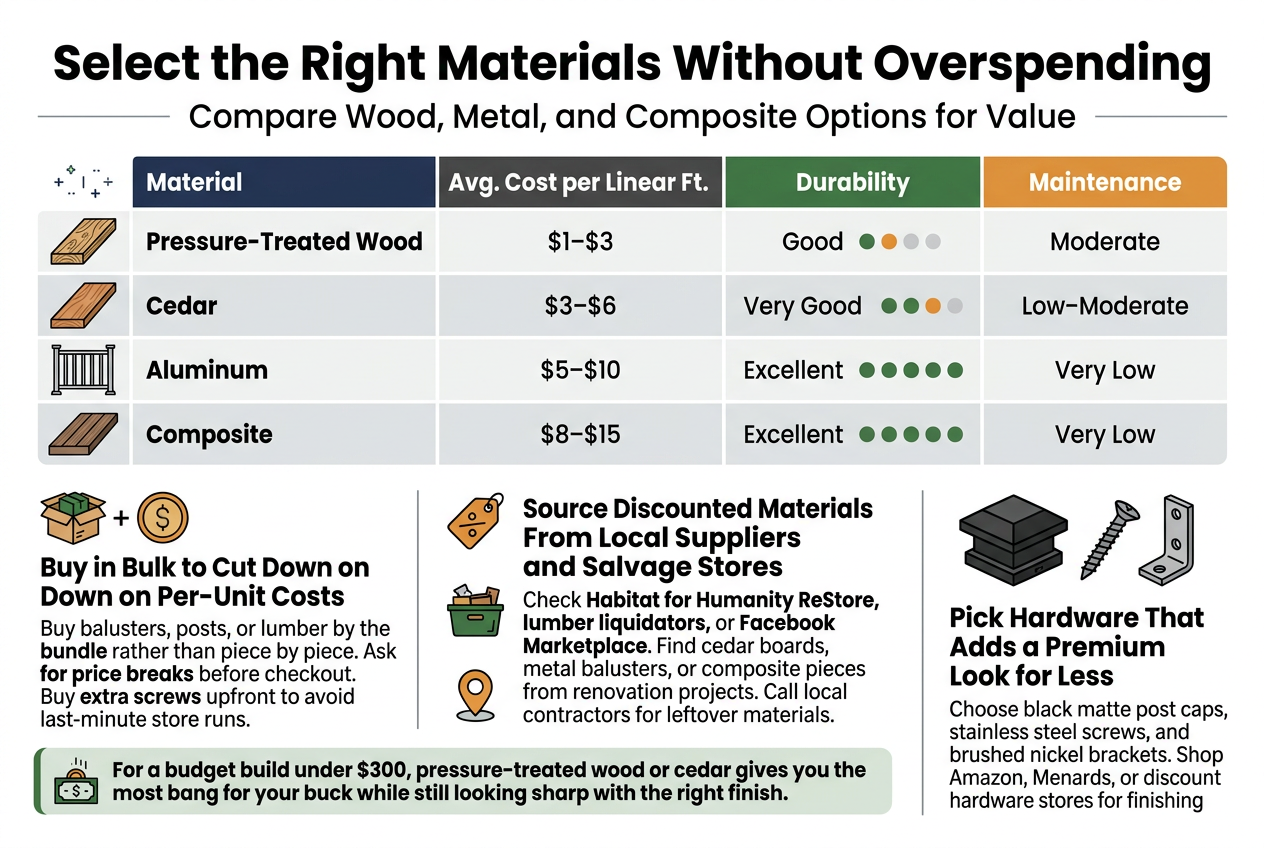
Picking the right material is where you either save big or blow your budget fast. Here’s a quick breakdown to help you decide:

MaterialAvg. Cost per Linear Ft.DurabilityMaintenance
Pressure-Treated Wood$1โ€“$3GoodModerate
Cedar$3โ€“$6Very GoodLowโ€“Moderate
Aluminum$5โ€“$10ExcellentVery Low
Composite$8โ€“$15ExcellentVery Low

For a budget build under $300, pressure-treated wood or cedar gives you the most bang for your buck while still looking sharp with the right finish.

Buy in Bulk to Cut Down on Per-Unit Costs

When you buy balusters, posts, or lumber by the bundle rather than piece by piece, your per-unit cost drops significantly. Most lumber yards reward bulk purchases with automatic price breaks, so always ask before you check out. Even grabbing an extra box of screws upfront saves you a last-minute hardware store run that always costs more.

Also Read  12 Stunning Deck Cover Ideas to Transform Your Outdoor Space Instantly

Source Discounted Materials From Local Suppliers and Salvage Stores

Your local Habitat for Humanity ReStore, lumber liquidators, or Facebook Marketplace can be goldmines for railing materials at a fraction of retail prices. You can often find cedar boards, metal balusters, or composite pieces pulled from renovation projects โ€” all in solid condition. Calling local contractors about leftover materials is another smart move most people skip.

Pick Hardware That Adds a Premium Look for Less

Your choice of hardware does more heavy lifting than you’d expect. Black matte post caps, stainless steel screws, and brushed nickel brackets make your railing look like it came from a high-end showroom without the price tag. Shop Amazon, Menards, or discount hardware stores to find these finishing pieces for a fraction of what big-box stores charge.

Gather the Tools You Need Before You Start
Create a clean professional infographic illustration in a full-bleed 3:2 layout, wide horizontal composition, no inset margins, no vertical poster frame. Use a modern home-improvement style with blue, teal, gray, and orange accents, white background, bold sans-serif fonts, clear hierarchy, and crisp vector icons.Top center: large bold headline in dark navy text: "Gather the Tools You Need Before You Start"Below the title, divide the layout into two wide horizontal sections.LEFT SECTION, labeled with a blue rounded header bar:"A. Identify the Essential Tools for a Smooth Build"Place a 2-column grid of 7 tool cards with simple flat icons and short labels. Each card has a small icon on the left and text on the right. Include these exact lines:1. "Circular saw or miter saw" with text beneath in smaller gray type: "for clean, accurate cuts on posts and balusters"2. "Drill and bits" with smaller gray type: "for driving screws and boring pilot holes"3. "Level" with smaller gray type: "to keep your rails perfectly straight"4. "Tape measure" with smaller gray type: "accuracy matters every single step of the way"5. "Speed square" with smaller gray type: "for checking 90-degree angles on your posts"6. "Post hole digger or impact driver" with smaller gray type: "depending on how you're anchoring"7. "Safety glasses and work gloves" with smaller gray type: "non-negotiable for protecting yourself"Use matching icons: circular saw, drill, spirit level, tape measure, speed square, post hole digger or impact driver, safety glasses and gloves. Add a small green checkmark badge on each card. At the bottom of this section, include a highlighted callout strip with the exact text: "Having these tools ready before day one saves you time, money, and a whole lot of headaches."RIGHT SECTION, labeled with an orange rounded header bar:"B. Rent Specialty Tools Instead of Buying Them"Place a clean 3-row table or three stacked rental cards with icons and pricing, aligned horizontally in a neat grid. Include column headers in bold:"Tool" | "Why You Need It" | "Avg. Rental Cost"Row 1: icon of a miter saw, text: "Power miter saw" | "Precise angled cuts on rail ends" | "$40โ€“$60/day"Row 2: icon of a rotary hammer drill, text: "Rotary hammer drill" | "Anchoring posts into concrete" | "$30โ€“$50/day"Row 3: icon of a post level, text: "Post level" | "Keeps multiple posts plumb simultaneously" | "$10โ€“$15/day"Add a small orange or teal rental tag icon beside the section header. At the bottom of this right section, add a bold callout in dark text inside a pale highlight box: "Renting saves you hundreds compared to buying, and you only pay for the day you actually need it."Use subtle divider lines, balanced spacing, and clear visual grouping. Keep all text sharp and legible, with icons large enough to quickly identify each tool.

A. Identify the Essential Tools for a Smooth Build

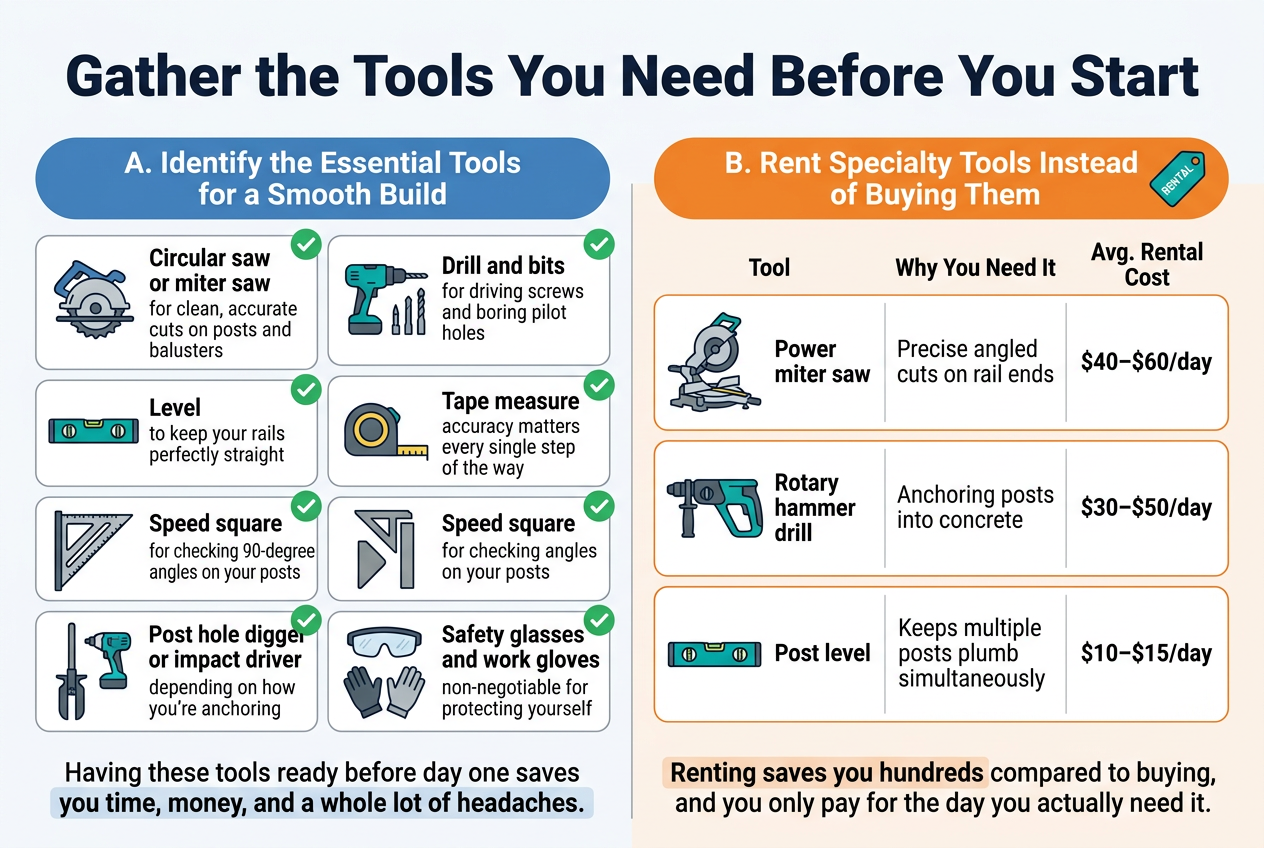
Before you cut a single board, make sure your workspace has everything you need to avoid frustrating mid-project runs to the hardware store. Your basic toolkit should include:

  • Circular saw or miter saw โ€“ for clean, accurate cuts on posts and balusters
  • Drill and bits โ€“ for driving screws and boring pilot holes
  • Level โ€“ to keep your rails perfectly straight
  • Tape measure โ€“ accuracy matters every single step of the way
  • Speed square โ€“ for checking 90-degree angles on your posts
  • Post hole digger or impact driver โ€“ depending on how you’re anchoring
  • Safety glasses and work gloves โ€“ non-negotiable for protecting yourself

Having these tools ready before day one saves you time, money, and a whole lot of headaches.

Also Read  Deck Building 2025: How to Build a Stunning DIY Deck That Lasts Decades!

B. Rent Specialty Tools Instead of Buying Them

Some tools are only worth having if you build decks every weekend. For a one-time project, renting makes way more sense for your wallet. Check your local home improvement store or tool rental shop for these:

ToolWhy You Need ItAvg. Rental Cost
Power miter sawPrecise angled cuts on rail ends$40โ€“$60/day
Rotary hammer drillAnchoring posts into concrete$30โ€“$50/day
Post levelKeeps multiple posts plumb simultaneously$10โ€“$15/day

Renting saves you hundreds compared to buying, and you only pay for the day you actually need it.

Build the Railing Step by Step for a Professional Finish
Create a full-bleed professional infographic illustration in a 3:2 aspect ratio, with a clean modern construction style, white background, navy blue and teal accents, orange safety highlights, and bold sans-serif typography.At the top, place a large bold headline: "Build the Railing Step by Step for a Professional Finish"Below the title, create five wide horizontal numbered sections laid out in a clean left-to-right or top-to-bottom sequence with clear visual hierarchy, each section using a circular number badge, a simple icon, a short subheading, and concise supporting text.Section 1, left side: a post-and-bolt icon showing a deck post being secured with carriage bolts and a level. Text: "1. Install Posts Securely" and smaller text: "Mark posts every 6โ€“8 ft. Bolt through the rim joist. Keep every post perfectly level."Section 2: a rail-measurement icon showing a tape measure and rail boards aligned at height. Text: "2. Cut and Attach Rails" and smaller text: "Set top rail at 36โ€“42 in. Measure from the decking. Pre-drill and screw at an angle."Section 3: a baluster-spacing icon showing evenly spaced vertical balusters with a ruler. Text: "3. Add Balusters Evenly" and smaller text: "Keep gaps no wider than 4 in. Mark positions carefully for a polished look."Section 4: a wrench-and-checkmark icon showing tightened connections and adhesive at a post base. Text: "4. Secure All Connections" and smaller text: "Tighten every screw. Add construction adhesive. Shake-test each post for wobble."Section 5: a sandpaper-and-smooth-surface icon showing sanded wood edges and a hand on the top rail. Text: "5. Sand and Smooth" and smaller text: "Use 80-grit, then 120-grit. Smooth cut ends and top rail for a refined finish."Use thin dividers or connected arrows between sections to suggest progression. Include small safety/code visual callouts near relevant sections: "36โ€“42 in" and "4 in max gap". Keep all text crisp, readable, and evenly spaced. Use a balanced wide layout with strong alignment, no centered vertical poster stack, and no inset frame.

Install Posts Securely to Ensure Safety and Stability

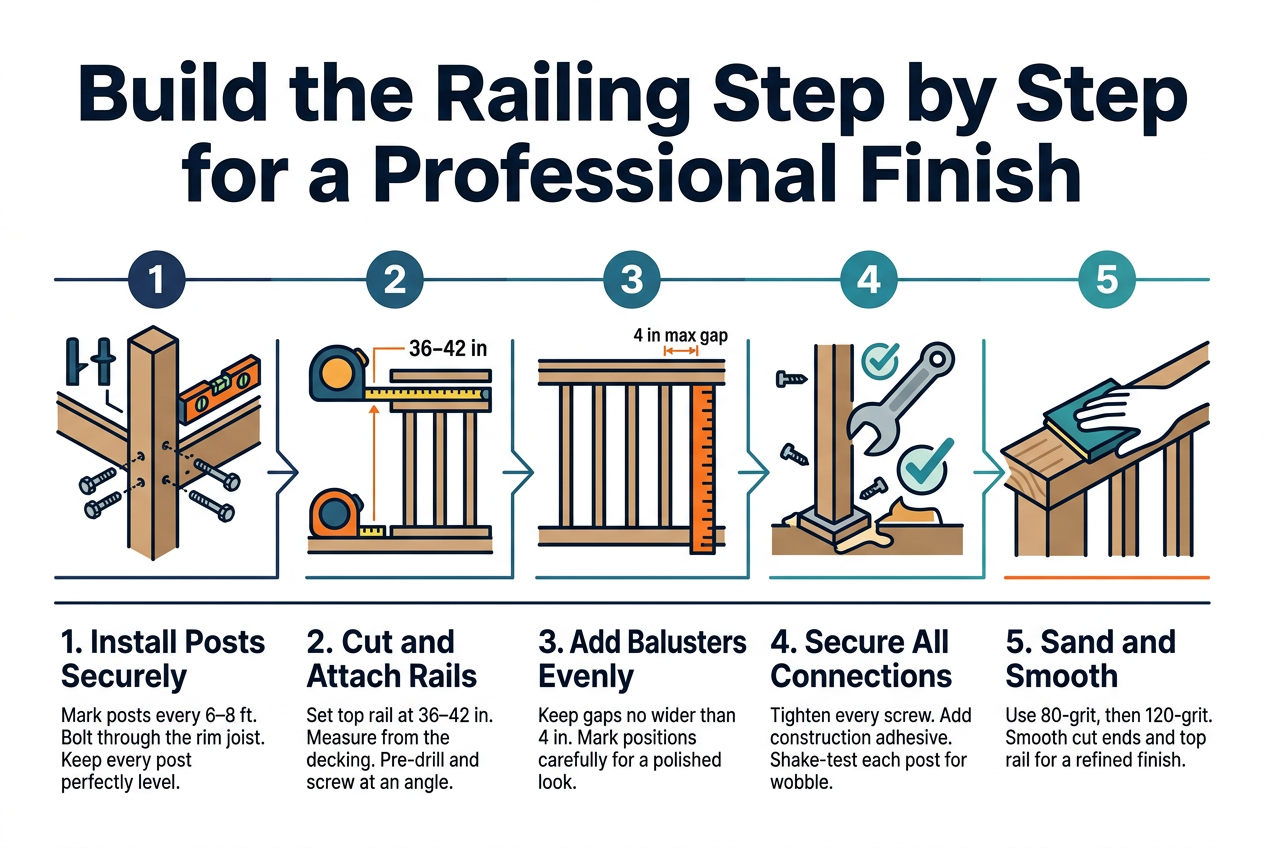
Start by marking your post locations every 6 to 8 feet along the deck edge. Drill through the decking and secure each post with 1/2-inch carriage bolts running through the rim joist. Use a level constantly โ€” even a slight lean will throw off your entire railing. Tighten every bolt fully before moving on.

Cut and Attach Rails at the Right Height for Code Compliance

Most building codes require your top rail to sit between 36 and 42 inches high, depending on your deck’s elevation. Measure from the decking surface up, mark each post at the same height, and cut your top and bottom rails to fit snugly between posts. Pre-drill your holes to avoid splitting the wood, then drive your screws at an angle for a stronger hold.

Add Balusters Evenly for a Clean and Polished Appearance

Spacing your balusters correctly is what separates a DIY-looking railing from one that looks professionally done. Keep gaps no wider than 4 inches to meet safety codes. To space them evenly, divide the total rail length by the number of balusters you need, then mark each position with a pencil before driving a single screw.

Secure All Connections to Prevent Wobbling and Wear

Go back over every connection point once everything is in place. Add construction adhesive at post bases for extra holding power, and double-check that no screws are backing out. A quick shake test on each post tells you right away if something needs tightening before you consider the frame finished.

Sand and Smooth All Surfaces for a Refined Look

Run 80-grit sandpaper over all cut ends and rough spots, then follow up with 120-grit for a smoother finish. Pay close attention to the top rail since that’s what people grab and run their hands along. Smooth edges not only look better โ€” they also help your stain or paint stick evenly for a finish that actually lasts.

You Might Also Like!

  • How to Build a Deck Off Back of House
    How To Build A Hog Wire Deck Railing: A Step-By-Step DIY Guide
  • 10 Stunning Backyard Water Features That Cost Under $300 to Build โ€” DIY Ideas to Transform Your Yard
  • Under Deck Storage Ideas
    10 Under Deck Storage Ideas to Maximize Space and Organization
Rafay Khan

Post navigation

Previous Previous
The $50 Raised Garden Bed Hack That Grows More Food Than a $500 Kit

You Might Also Like!

  • How to Build a Deck Off Back of House
    How To Build A Hog Wire Deck Railing: A Step-By-Step DIY Guide
  • 10 Stunning Backyard Water Features That Cost Under $300 to Build โ€” DIY Ideas to Transform Your Yard
  • Under Deck Storage Ideas
    10 Under Deck Storage Ideas to Maximize Space and Organization

Search More!

About DearWorld

We share practical DIY tips, budget-friendly ideas, and creative inspiration for mobile homes, backyards, patios, porches, gardens, and skirting. Helping you make every space feel like home โ€” one project at a time.

  • About Us
  • Privacy Policy
  • Terms & Conditions
  • Blog

© 2026 Dear World - WordPress Theme by Kadence WP

Facebook Instagram Pinterest
Scroll to top
  • Home Improvement
    • Deck
    • Barn Doors
    • Patio
    • Bathroom
    • Garden Beds
    • Winter Home Prep
  • Mobile Home
    • Crawl Space
    • Skirting
  • Backyard
    • Landscaping
    • Curb Appeal
    • Water Features
  • Porch
  • Garden
  • Contact
Search