Skip to content

[email protected] | About Us | Privacy Policy | Terms Of Use

Facebook Pinterest
logo
  • Home ImprovementExpand
    • Deck
    • Barn Doors
    • Patio
    • Bathroom
    • Garden Beds
    • Winter Home Prep
  • Mobile HomeExpand
    • Crawl Space
    • Skirting
  • BackyardExpand
    • Landscaping
    • Curb Appeal
    • Water Features
  • Porch
  • Garden
  • Contact
logo
Hog Wire Ideas

The Hog Wire Railing Trick Every DIYer Is Doing Right Now (Step-by-Step)

If you’ve been scrolling through home improvement feeds lately, you’ve probably noticed hog wire railings showing up everywhere — on decks, porches, and staircases that used to look completely forgettable. There’s a good reason for that. This DIY hog wire railing project gives you a clean, modern look without the price tag of hiring a contractor, and it’s more doable than you’d think even if you’re not a seasoned builder.

This guide is for you — the homeowner who wants a solid weekend project that actually adds value and curb appeal to your space.

Here’s what you’ll get out of this:

  • A full step-by-step breakdown of how to build your hog wire railing from scratch, including the tools and materials you need before you touch anything
  • The most common mistakes DIYers make so you can skip the frustrating part and get it right the first time
  • Easy ways to customize your railing so it fits your style, not just the trend

By the end, you’ll know exactly what to buy, what to avoid, and how to keep your railing looking sharp for years to come. Let’s get into it.

Contents

Toggle
    • You Might Also Love These Ideas
      • 10 DIY Dog Run Ideas with Attached House Access —…
      • 10 Hog Wire Fence Ideas for a Safe & Dog-Friendly…
      • DIY Fix for Hog Wire Fence Gaps on Sloped Yards
  • Why Hog Wire Railings Are Taking Over DIY Projects
      • The Rustic Yet Modern Look That Fits Any Home Style
      • How Hog Wire Outperforms Traditional Railing Materials in Durability
      • The Cost Savings That Make This Project a No-Brainer
  • Tools and Materials You Need Before You Start
      • Choosing the Right Gauge Hog Wire Panel for Your Railing
      • Essential Tools That Make Installation Faster and Easier
      • Selecting the Best Wood or Metal Posts for a Sturdy Frame
      • Safety Gear You Should Never Skip on This Build
  • Step-by-Step Guide to Building Your Hog Wire Railing
      • Measuring and Planning Your Railing Layout for a Perfect Fit
      • Cutting and Preparing Your Posts and Frame Pieces
      • Securing the Frame in Place for Maximum Stability
      • Stretching and Attaching the Hog Wire Panel Without Sagging
      • Finishing and Sealing the Wood to Protect Against Weather Damage
      • You Might Also Like!

You Might Also Love These Ideas

How to Build a Deck Off Back of House

How To Build A Hog Wire Deck Railing: A Step-By-Step…

10 Hog Wire Fence Ideas for a Safe & Dog-Friendly Backyard

10 Hog Wire Fence Ideas for a Safe & Dog-Friendly…

Wood & Wire Fence Ideas

10 Low-Maintenance Wood & Wire Fence Ideas for Busy Homeowners…

Why Hog Wire Railings Are Taking Over DIY Projects

Create a full-bleed 3:2 horizontal infographic illustration with a clean modern rustic style, white background with subtle light wood and steel-gray accents, bold sans-serif typography, and a polished professional layout.Top header across the full width: large bold title in dark charcoal text, centered-left:"Why Hog Wire Railings Are Taking Over DIY Projects"Under the title, a smaller subtitle in muted gray:"The Rustic Yet Modern Look That Fits Any Home Style"Use a three-section wide horizontal layout with numbered blocks and simple icons:LEFT SECTION — “1”Add a warm farmhouse-and-modern style icon showing a deck railing with galvanized steel mesh and wood posts. Include a small label block:"Rustic Yet Modern Look"Body text below in smaller font:"Balances raw, industrial charm with clean modern lines.""Fits farmhouse, contemporary, and mixed home styles.""Upgrades decks, porches, and staircases with a polished look."CENTER SECTION — “2”Add a durability icon showing rain, sun, and a steel shield over railing mesh. Include a small label block:"Built for Durability"Body text below in smaller font:"Galvanized steel resists rain, sun, and temperature swings.""Unlike wood, it does not rot.""Unlike vinyl, it does not crack under UV exposure.""Stays structurally solid for years with little maintenance."RIGHT SECTION — “3”Add a money-saving icon showing a price tag and downward arrow. Include a comparison table in a clean boxed panel with alternating light rows and bold highlight for the last row. Title above the table:"Cost Savings"Table text exactly:"Railing Type | Avg. Cost per Linear Foot""Wrought Iron | $150–$300""Glass Panel | $130–$220""Cable Railing | $100–$200""Hog Wire DIY | $20–$50"Below the table, add a bold callout in green:"High-end look at a fraction of the price"And a smaller line:"DIY labor savings add up fast."Add subtle section dividers, clear spacing, and icon markers beside each numbered block. Use charcoal, steel gray, muted green, and warm tan colors. Keep the design balanced, wide, and easy to scan, with all text crisp and legible.

The Rustic Yet Modern Look That Fits Any Home Style

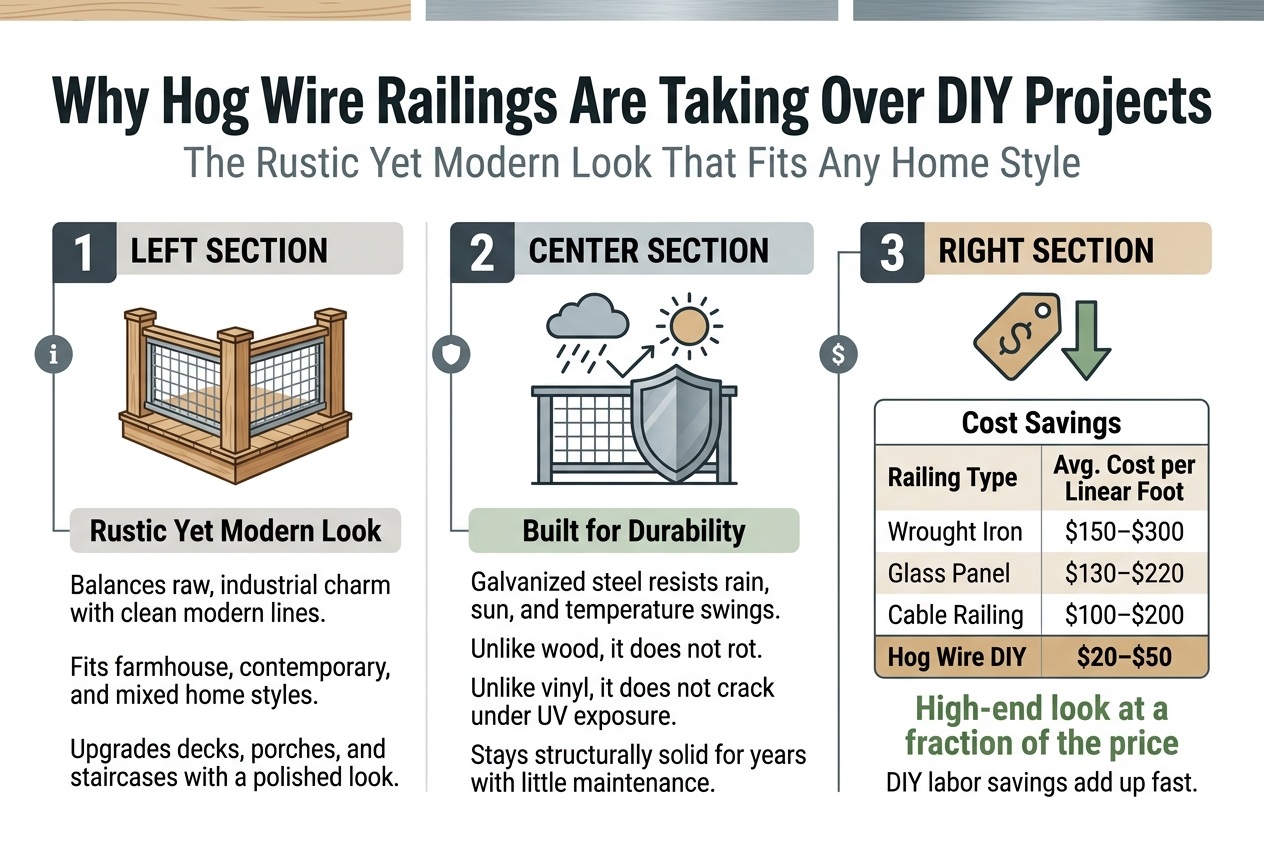
Hog wire railings give your space that perfect balance of raw, industrial charm and clean modern lines. Whether your home leans farmhouse, contemporary, or somewhere in between, this style slots right in without looking forced. Your deck, porch, or staircase instantly gets a character upgrade that feels intentional and polished.

Also Read  10 Hog Wire Fence Ideas for a Safe & Dog-Friendly Backyard

How Hog Wire Outperforms Traditional Railing Materials in Durability

When you choose hog wire, you’re picking a material built to handle real outdoor punishment. Unlike wood that rots or vinyl that cracks under UV exposure, galvanized steel hog wire shrugs off rain, sun, and temperature swings without flinching. Your railing stays structurally solid for years with very little effort on your end.

The Cost Savings That Make This Project a No-Brainer

Here’s a quick comparison so you can see exactly what your wallet is dealing with:

Railing TypeAvg. Cost per Linear Foot
Wrought Iron$150–$300
Glass Panel$130–$220
Cable Railing$100–$200
Hog Wire DIY$20–$50

You’re getting a high-end look at a fraction of the price, and since you’re doing it yourself, the labor savings stack up fast.

Tools and Materials You Need Before You Start
Create a clean professional full-bleed infographic illustration in 3:2 aspect ratio, with a modern home-improvement style, white background, dark charcoal text, muted teal and warm orange accents, bold sans-serif heading, smaller readable sans-serif body text, and clear section dividers. Use a wide horizontal layout with 4 main content blocks arranged in two rows, not a narrow centered poster.Top banner across the full width:Large bold title text: "Tools and Materials You Need Before You Start"Small subtitle text beneath: "Choosing the Right Gauge Hog Wire Panel for Your Railing"Section 1 on the upper left, with a wire panel icon and a small checklist badge:Heading: "Choosing the Right Gauge Hog Wire Panel"Body text: "Go with 4-gauge or 6-gauge welded wire panels for railings that need to handle pressure and movement."Body text: "A 4\"x4\" or 2\"x4\" grid opening gives you a clean, open look while keeping the structure solid enough to pass most local building codes."Include a small comparison table beside or below with three rows and three columns labeled:"Gauge" | "Best Use" | "Durability""4-gauge" | "High-traffic decks, stairs" | "Excellent""6-gauge" | "Standard deck railings" | "Very Good""9-gauge" | "Light decorative use only" | "Moderate"Use a simple gauge scale icon or stacked wire grid icon next to the table.Section 2 on the upper right, with tool icons arranged in a neat grid:Heading: "Essential Tools That Make Installation Faster and Easier"Use six labeled tool icons with short captions:"Circular saw or miter saw""Drill with bits""Come-along or wire stretcher""Level""Staple gun or fencing staples""Tape measure and speed square"Make each tool a separate icon tile with small labels.Section 3 on the lower left, with a post and frame icon:Heading: "Selecting the Best Wood or Metal Posts for a Sturdy Frame"Body text: "4x4 cedar or pressure-treated pine is your best budget-friendly wood option."Body text: "Cedar naturally resists rot and insects without extra treatment."Body text: "For decades of durability with zero warping, go with steel square tubing (2\"x2\" or larger)."Body text: "Steel pairs beautifully with hog wire and gives your railing a clean, modern look."Show two side-by-side visual callouts: one wood post illustration labeled "4x4 cedar" and "pressure-treated pine", and one steel tubing illustration labeled "steel square tubing (2\"x2\" or larger)".Section 4 on the lower right, with safety gear icons and warning accents:Heading: "Safety Gear You Should Never Skip on This Build"Use four clear icon labels in a row or 2x2 grid:"Heavy-duty work gloves""Safety glasses""Steel-toed boots""Hearing protection"Add a short warning line below: "Your eyes and hands are too important to risk skipping this stuff, no matter how quick the job feels."Use clean line icons, subtle shadows, and strong spacing. Keep all text crisp and fully readable. Include small checkmarks and accent lines to guide the eye. No extra text beyond the words specified.

Choosing the Right Gauge Hog Wire Panel for Your Railing

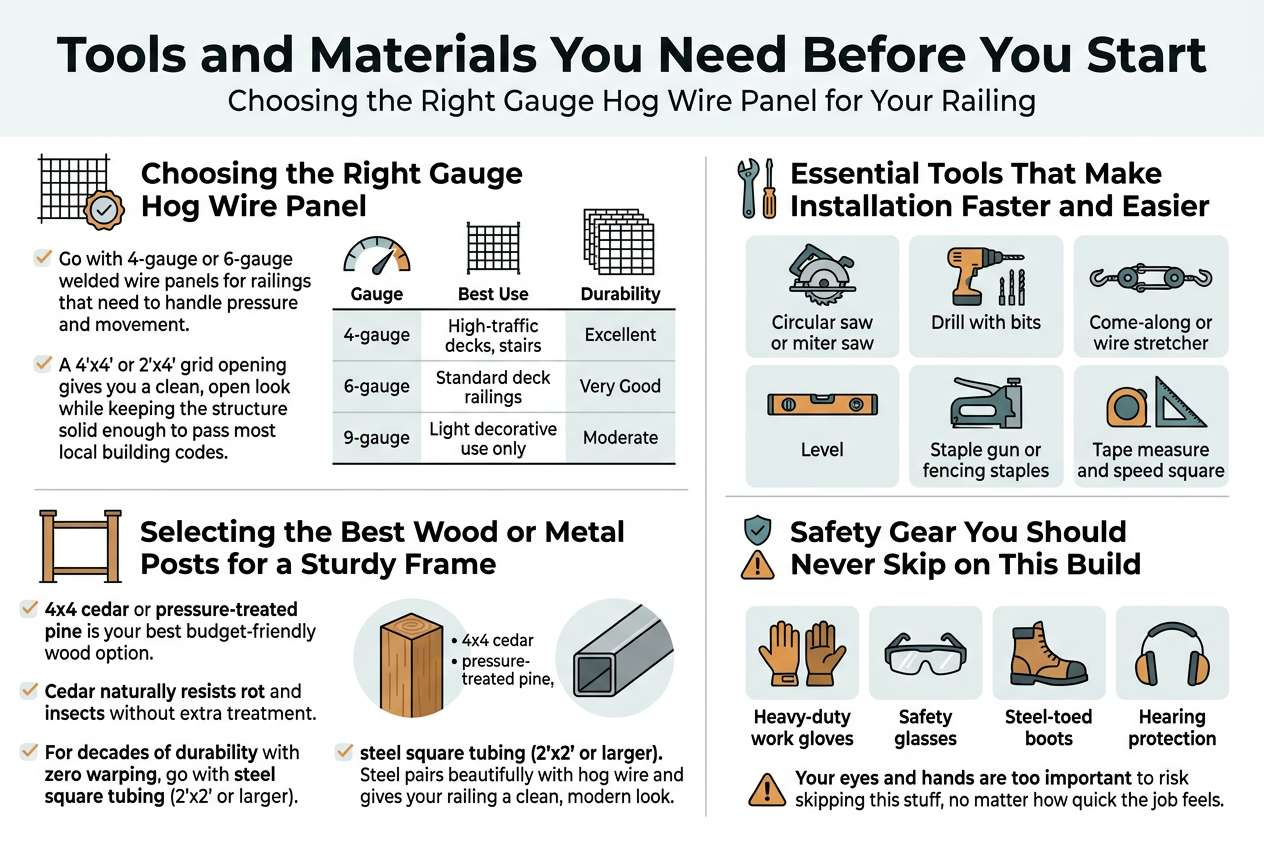
Your panel choice makes or breaks the whole project. Go with 4-gauge or 6-gauge welded wire panels for railings that need to handle pressure and movement. Thinner gauges flex too much and look cheap fast. A 4″x4″ or 2″x4″ grid opening gives you that clean, open look while keeping the structure solid enough to pass most local building codes.

GaugeBest UseDurability
4-gaugeHigh-traffic decks, stairsExcellent
6-gaugeStandard deck railingsVery Good
9-gaugeLight decorative use onlyModerate

Essential Tools That Make Installation Faster and Easier

Having the right tools in your hands before you start saves you a frustrating mid-project hardware store run. Here’s what you actually need:

  • Circular saw or miter saw for clean post cuts
  • Drill with bits for pilot holes and screws
  • Come-along or wire stretcher to pull panels tight without sagging
  • Level to keep everything straight
  • Staple gun or fencing staples for securing wire edges
  • Tape measure and speed square for accurate spacing
Also Read  10 DIY Dog Run Ideas with Attached House Access — Stunning Budget Transformations

Selecting the Best Wood or Metal Posts for a Sturdy Frame

Your posts carry the whole load, so don’t cut corners here. 4×4 cedar or pressure-treated pine is your best budget-friendly wood option — cedar naturally resists rot and insects without extra treatment. If you want something that lasts decades with zero warping, go with steel square tubing (2″x2″ or larger). Steel pairs beautifully with hog wire and gives your railing a clean, modern look that wood sometimes can’t match.


Safety Gear You Should Never Skip on This Build

Working with wire panels and power tools means sharp edges and flying debris are part of the deal. Always wear:

  • Heavy-duty work gloves — hog wire edges are razor sharp when cut
  • Safety glasses — wire snips send tiny metal pieces flying at eye level
  • Steel-toed boots — panels are heavy and drop fast
  • Hearing protection — if you’re cutting metal posts with a grinder or saw

Your eyes and hands are too important to risk skipping this stuff, no matter how quick the job feels.

Step-by-Step Guide to Building Your Hog Wire Railing
Create a clean professional full-bleed infographic in a 3:2 aspect ratio about building a hog wire railing, with a modern DIY construction style. Use a white background with dark charcoal text, muted forest green and warm wood-brown accents, and thin gray divider lines. Use bold sans-serif fonts for headings and smaller readable sans-serif body text. Place a large bold title across the top: "Step-by-Step Guide to Building Your Hog Wire Railing"Below the title, arrange five wide horizontal numbered sections in a balanced two-column layout across the page, not a narrow vertical stack. Each section should have a colored circular number badge on the left, a simple matching icon, a bold subheading, and 1–2 short lines of body text. Use clear visual hierarchy and generous spacing.Section 1 at upper left: a tape measure icon and the subheading "1. Measuring and Planning Your Railing Layout for a Perfect Fit"Body text: "Grab your tape measure and note every dimension — post spacing, height, and total run length. Posts should sit no more than 6–8 feet apart to keep wire tension consistent and prevent sagging."Section 2 at upper right: a miter saw icon and the subheading "2. Cutting and Preparing Your Posts and Frame Pieces"Body text: "Cut your 4x4 posts and 2x4 top and bottom rails to measured lengths. Sand cut edges smooth and pre-drill pilot holes to prevent splitting."Section 3 at middle left: a concrete footing and level icon and the subheading "3. Securing the Frame in Place for Maximum Stability"Body text: "Set posts in concrete footings 18–24 inches deep or bolt them to deck framing with heavy-duty post base hardware. Check plumb with a level before the concrete sets."Section 4 at middle right: a hog wire mesh panel, fence pliers, and staple icon and the subheading "4. Stretching and Attaching the Hog Wire Panel Without Sagging"Body text: "Unroll the hog wire panel, fasten one end to the frame, then pull the opposite end tight with fence pliers or a come-along before securing. Keep even tension from top to bottom."Section 5 across the bottom full width: a paintbrush and sealant can icon and the subheading "5. Finishing and Sealing the Wood to Protect Against Weather Damage"Body text: "Apply exterior wood sealant or stain to every exposed surface, especially end grains. Two coats give better protection than one, especially on posts close to the ground."Add subtle small decorative line-art details of wood grain and mesh wire in the background, keeping the layout clean and uncluttered. Use clear icons, strong alignment, and a polished instructional infographic style.

Measuring and Planning Your Railing Layout for a Perfect Fit

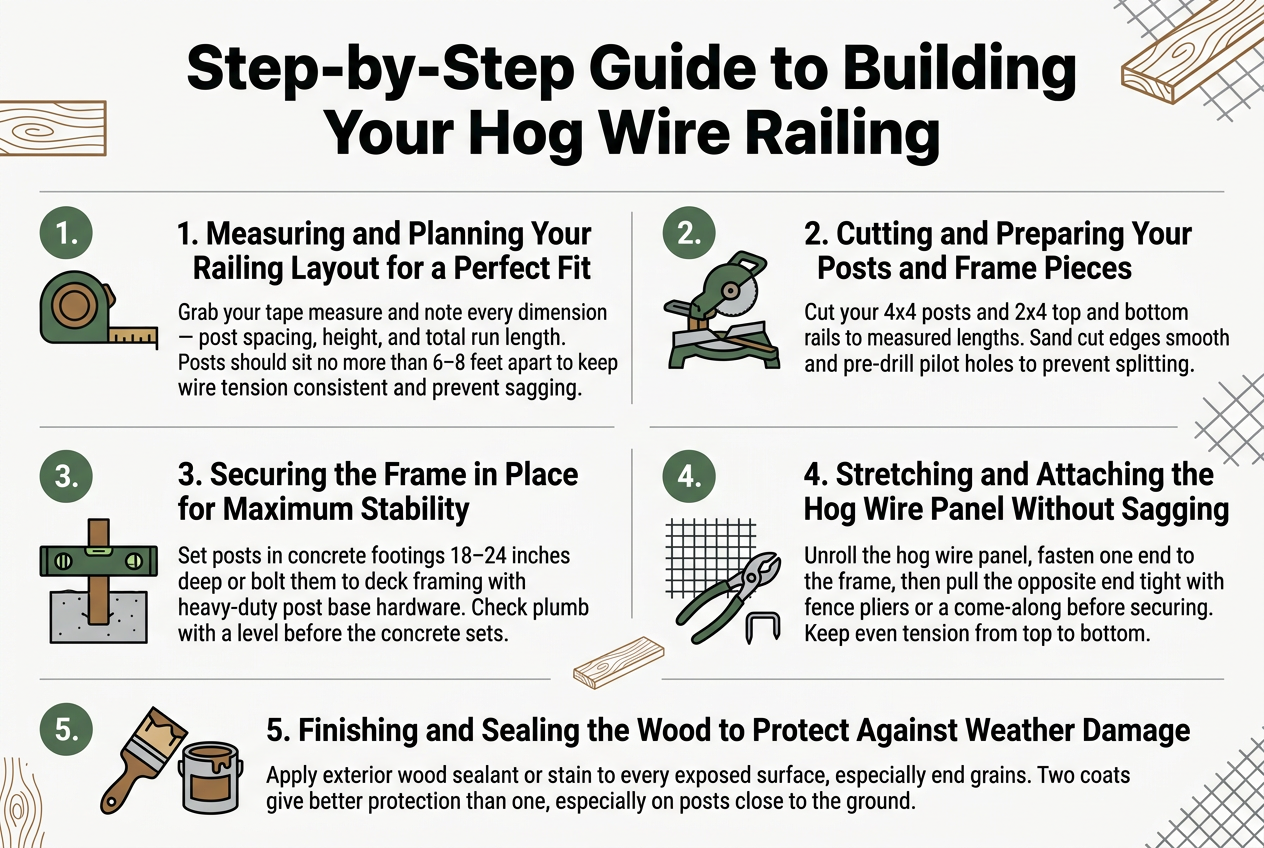
Grab your tape measure and note every dimension — post spacing, height, and total run length. Your panels work best when posts sit no more than 6–8 feet apart, keeping wire tension consistent and preventing future sagging.

Cutting and Preparing Your Posts and Frame Pieces

Cut your 4×4 posts and 2×4 top and bottom rails to your measured lengths using a miter saw. Sand every cut edge smooth so your hands don’t catch splinters during assembly, and pre-drill pilot holes to stop the wood from splitting when you drive your screws in.

Also Read  10 Hog Wire Fence Ideas That Look Stylish and Last for Years

Securing the Frame in Place for Maximum Stability

Set your posts in concrete footings at least 18–24 inches deep, or bolt them directly to your deck framing using heavy-duty post base hardware. Check plumb on every post with a level before your concrete sets — a crooked post throws off your entire railing line.

Stretching and Attaching the Hog Wire Panel Without Sagging

Unroll your hog wire panel, start stapling or screwing one end to your frame using fence staples or hog ring clips, then pull the opposite end tight with fence pliers or a come-along before fastening. Work top to bottom, keeping even tension across the whole panel so no section bulges outward.

Finishing and Sealing the Wood to Protect Against Weather Damage

Once your railing is assembled, apply a quality exterior wood sealant or stain to every exposed surface, working it into end grains where moisture loves to sneak in and cause rot fastest. Two coats give you far better protection than one, especially on posts sitting close to the ground.

You Might Also Like!

  • How to Build a Deck Off Back of House
    How To Build A Hog Wire Deck Railing: A Step-By-Step DIY Guide
  • 10 Hog Wire Fence Ideas for a Safe & Dog-Friendly Backyard
    10 Hog Wire Fence Ideas for a Safe & Dog-Friendly Backyard
  • DIY Fix for Hog Wire Fence Gaps
    DIY Fix for Hog Wire Fence Gaps on Sloped Yards
Rafay Khan

Post navigation

Previous Previous
Build a DIY Backyard Waterfall for Under $200 (No Plumber Needed)
NextContinue
The Solar Fountain Trick That Runs All Day for Free (No Wiring Required)

You Might Also Like!

  • How to Build a Deck Off Back of House
    How To Build A Hog Wire Deck Railing: A Step-By-Step DIY Guide
  • 10 Hog Wire Fence Ideas for a Safe & Dog-Friendly Backyard
    10 Hog Wire Fence Ideas for a Safe & Dog-Friendly Backyard
  • DIY Fix for Hog Wire Fence Gaps
    DIY Fix for Hog Wire Fence Gaps on Sloped Yards

Search More!

About DearWorld

We share practical DIY tips, budget-friendly ideas, and creative inspiration for mobile homes, backyards, patios, porches, gardens, and skirting. Helping you make every space feel like home — one project at a time.

  • About Us
  • Privacy Policy
  • Terms & Conditions
  • Blog

© 2026 Dear World - WordPress Theme by Kadence WP

Facebook Instagram Pinterest
Scroll to top
  • Home Improvement
    • Deck
    • Barn Doors
    • Patio
    • Bathroom
    • Garden Beds
    • Winter Home Prep
  • Mobile Home
    • Crawl Space
    • Skirting
  • Backyard
    • Landscaping
    • Curb Appeal
    • Water Features
  • Porch
  • Garden
  • Contact
Search