Skip to content

[email protected] | About Us |ย Privacy Policy | Terms Of Use

Facebook Pinterest
logo
  • Home ImprovementExpand
    • Deck
    • Barn Doors
    • Patio
    • Bathroom
    • Garden Beds
    • Winter Home Prep
  • Mobile HomeExpand
    • Crawl Space
    • Skirting
  • BackyardExpand
    • Landscaping
    • Curb Appeal
    • Water Features
  • Porch
  • Garden
  • Contact
logo
Pet Ideas

How to Carry Your Dog Safely (Proper Lifting Techniques)

Carrying your dog safely protects both you and your furry friend from injury. Dog owners, pet sitters, and veterinary staff need proper lifting techniques to avoid back strain, dropped pets, and stressed animals.

You’ll learn how to recognize when your dog needs to be carried and how to prepare your body before lifting. We’ll cover the step-by-step proper dog lifting technique that works for different dog sizes, from tiny Chihuahuas to hefty Golden Retrievers. You’ll also discover the most common lifting mistakes that lead to injuries and how to create secure carrying positions that keep your dog calm during transport.

Contents

Toggle
  • Understand When Your Dog Needs to Be Carried
      • Recognize Signs of Injury or Fatigue
      • Identify Age-Related Mobility Issues
      • Assess Dangerous Environmental Conditions
      • Determine Medical Necessity Situations
  • Prepare Your Body for Safe Dog Lifting
      • Strengthen your core muscles for stability
      • Warm up with proper stretching exercises
      • Choose appropriate footwear for grip and support
  • Master the Proper Dog Lifting Technique
      • Position yourself correctly beside your dog
      • Secure your grip using the cradle method
      • Engage your legs while keeping your back straight
      • Lift smoothly without jerking motions
      • Maintain control throughout the entire lift
  • Adapt Techniques for Different Dog Sizes
      • Handle small dogs with gentle chest support
      • Carry medium dogs using the two-arm technique
      • Manage large dogs with team lifting methods
  • Avoid Common Lifting Mistakes That Cause Injury
      • Never grab dogs by their limbs or tail
      • Avoid sudden twisting motions while carrying
      • Don’t lift beyond your physical capabilities
      • Prevent dropping by maintaining secure grip
      • You Might Also Like!

Understand When Your Dog Needs to Be Carried

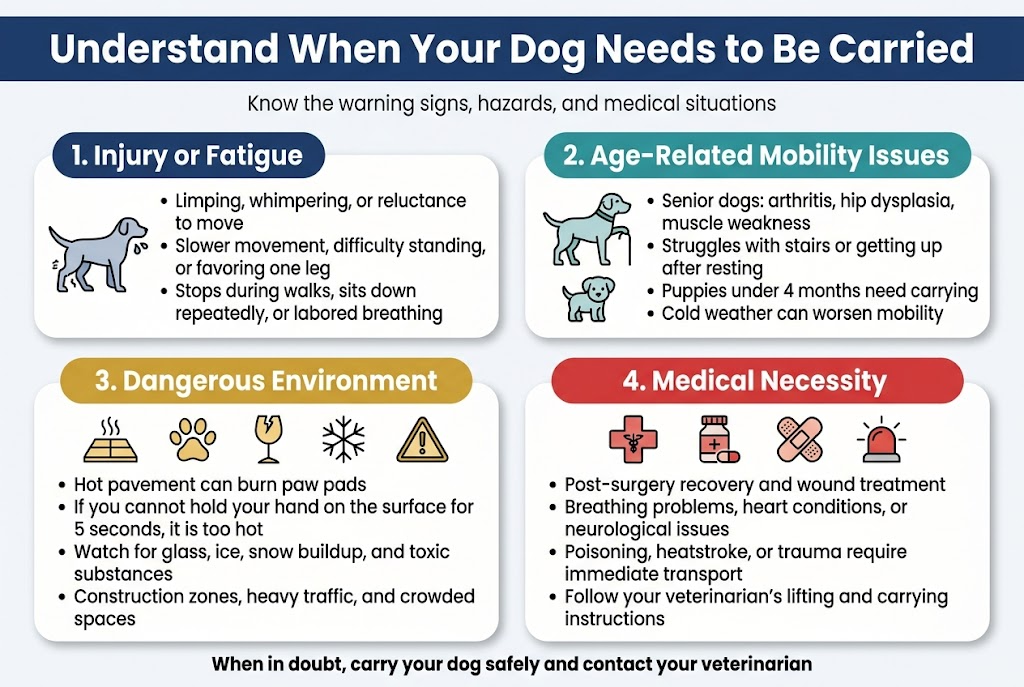
Create a clean, professional infographic in a 3:2 aspect ratio with a full-bleed layout and no poster frame. Use a wide horizontal composition with a bold top title bar, followed by four evenly spaced content sections across the page in a 2x2 grid. Modern sans-serif typography, strong visual hierarchy, white background with navy, teal, gold, and red accent colors. Include clear section icons and short readable text blocks.Top header centered across the full width:Title in large bold text: "Understand When Your Dog Needs to Be Carried"Subtle small subtitle beneath in lighter text: "Know the warning signs, hazards, and medical situations"Section 1 on upper left:Heading in bold: "1. Injury or Fatigue"Icon: a dog with a limp plus a small panting symbolInclude bullet points:โ€ข "Limping, whimpering, or reluctance to move"โ€ข "Slower movement, difficulty standing, or favoring one leg"โ€ข "Stops during walks, sits down repeatedly, or labored breathing"Section 2 on upper right:Heading in bold: "2. Age-Related Mobility Issues"Icon: a senior dog with a cane-style support symbol and a puppy iconInclude bullet points:โ€ข "Senior dogs: arthritis, hip dysplasia, muscle weakness"โ€ข "Struggles with stairs or getting up after resting"โ€ข "Puppies under 4 months need carrying"โ€ข "Cold weather can worsen mobility"Section 3 on lower left:Heading in bold: "3. Dangerous Environment"Icon: a hot pavement tile, paw print, broken glass, snowflake, and traffic warning triangleInclude bullet points:โ€ข "Hot pavement can burn paw pads"โ€ข "If you cannot hold your hand on the surface for 5 seconds, it is too hot"โ€ข "Watch for glass, ice, snow buildup, and toxic substances"โ€ข "Construction zones, heavy traffic, and crowded spaces"Section 4 on lower right:Heading in bold: "4. Medical Necessity"Icon: a veterinary cross, pill bottle, bandage, and emergency sirenInclude bullet points:โ€ข "Post-surgery recovery and wound treatment"โ€ข "Breathing problems, heart conditions, or neurological issues"โ€ข "Poisoning, heatstroke, or trauma require immediate transport"โ€ข "Follow your veterinarianโ€™s lifting and carrying instructions"Bottom footer strip across the width:Small bold reminder text: "When in doubt, carry your dog safely and contact your veterinarian"Use simple line icons, rounded section cards, subtle shadowing, and color-coded headings. Keep text crisp and legible, with balanced spacing and a clean medical-pet-care infographic style.

Recognize Signs of Injury or Fatigue

Watch for limping, excessive panting, reluctance to move, or whimpering that signals your dog needs immediate assistance. Dogs often hide pain, so notice subtle changes like slower movements, difficulty standing, or favoring one leg. If your dog suddenly stops during walks, sits down repeatedly, or shows labored breathing, they’re telling you they can’t continue safely on their own.

Also Read  Hobby Farm Layout Ideas for Homes With Dogs and Animals: Safe, Budget-Friendly Transformations

Identify Age-Related Mobility Issues

Senior dogs frequently develop arthritis, hip dysplasia, or muscle weakness that makes walking challenging. You’ll notice your older dog struggling with stairs, taking longer to get up from lying down, or moving stiffly after rest. Puppies under four months also need carrying since their joints and growth plates are still developing. Cold weather often worsens mobility issues in aging dogs.

Assess Dangerous Environmental Conditions

Hot pavement can burn your dog’s paw pads in seconds – if you can’t hold your hand on the surface for five seconds, it’s too hot for paws. Sharp objects, broken glass, ice, snow buildup between toes, or toxic substances like antifreeze create immediate hazards. Construction zones, heavy traffic areas, and crowded spaces where your dog might get stepped on require safe transport.

Determine Medical Necessity Situations

Post-surgery recovery, wound treatment, or illness often requires strict movement restrictions your vet will specify. Dogs with breathing problems, heart conditions, or neurological issues may need assistance during episodes. Emergency situations like poisoning, heatstroke, or trauma demand immediate transport to prevent further injury. Always follow your veterinarian’s specific lifting and carrying instructions for medical conditions.

Prepare Your Body for Safe Dog Lifting
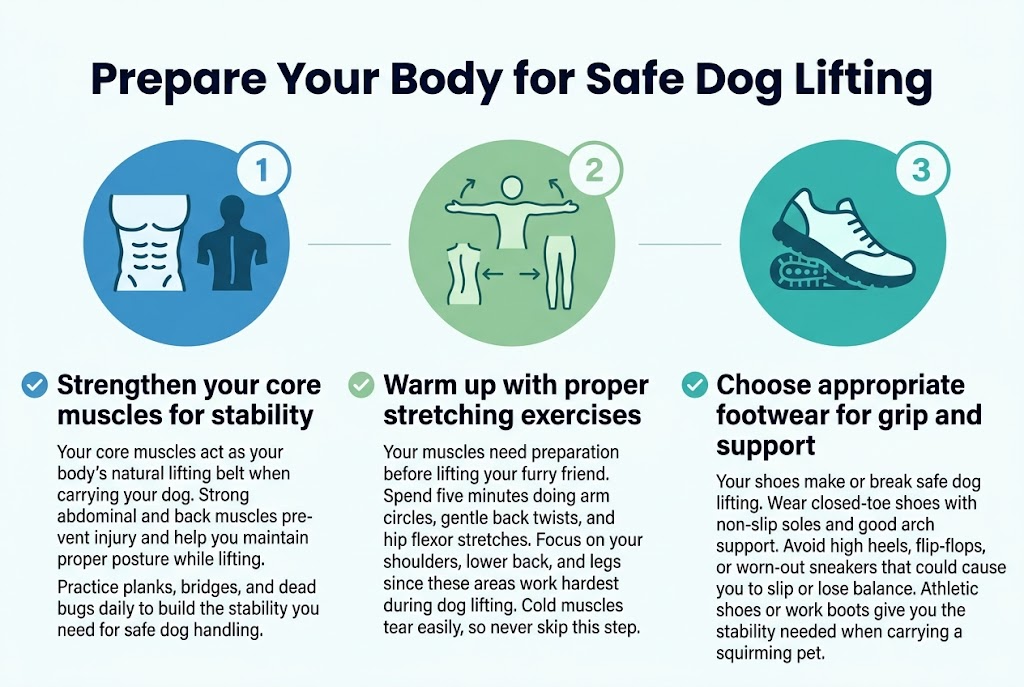
Create a clean, professional full-bleed infographic in a 3:2 aspect ratio with a modern veterinary/fitness style. Use a white background with teal, blue, and soft green accents, bold dark navy headings, and simple flat vector icons. Place a large bold title at the top center: "Prepare Your Body for Safe Dog Lifting".Below the title, arrange three wide horizontal sections across the page in a 3-column layout, each with a numbered circle, a large icon, a bold subheading, and short body text. Use clear visual hierarchy, generous spacing, and simple illustrated symbols.Left section:A blue circular icon with a strong core, abs, and back silhouette. Numbered circle "1".Bold heading: "Strengthen your core muscles for stability"Body text: "Your core muscles act as your body's natural lifting belt when carrying your dog. Strong abdominal and back muscles prevent injury and help you maintain proper posture while lifting. Practice planks, bridges, and dead bugs daily to build the stability you need for safe dog handling."Center section:A green circular icon with stretched arms, back, hips, and legs. Numbered circle "2".Bold heading: "Warm up with proper stretching exercises"Body text: "Your muscles need preparation before lifting your furry friend. Spend five minutes doing arm circles, gentle back twists, and hip flexor stretches. Focus on your shoulders, lower back, and legs since these areas work hardest during dog lifting. Cold muscles tear easily, so never skip this step."Right section:A teal circular icon with a closed-toe athletic shoe and grip sole. Numbered circle "3".Bold heading: "Choose appropriate footwear for grip and support"Body text: "Your shoes make or break safe dog lifting. Wear closed-toe shoes with non-slip soles and good arch support. Avoid high heels, flip-flops, or worn-out sneakers that could cause you to slip or lose balance. Athletic shoes or work boots give you the stability needed when carrying a squirming pet."Use small supporting checkmark icons near key phrases, and subtle divider lines between the sections. Keep the layout wide and balanced, not vertical. Make all text crisp, readable, and aligned neatly. No extra text.

Strengthen your core muscles for stability

Your core muscles act as your body’s natural lifting belt when carrying your dog. Strong abdominal and back muscles prevent injury and help you maintain proper posture while lifting. Practice planks, bridges, and dead bugs daily to build the stability you need for safe dog handling.

Warm up with proper stretching exercises

Your muscles need preparation before lifting your furry friend. Spend five minutes doing arm circles, gentle back twists, and hip flexor stretches. Focus on your shoulders, lower back, and legs since these areas work hardest during dog lifting. Cold muscles tear easily, so never skip this step.

Choose appropriate footwear for grip and support

Your shoes make or break safe dog lifting. Wear closed-toe shoes with non-slip soles and good arch support. Avoid high heels, flip-flops, or worn-out sneakers that could cause you to slip or lose balance. Athletic shoes or work boots give you the stability needed when carrying a squirming pet.

Also Read  8 Fresh No-Bake Dog Treat Recipes You Can Make Anytime

Master the Proper Dog Lifting Technique
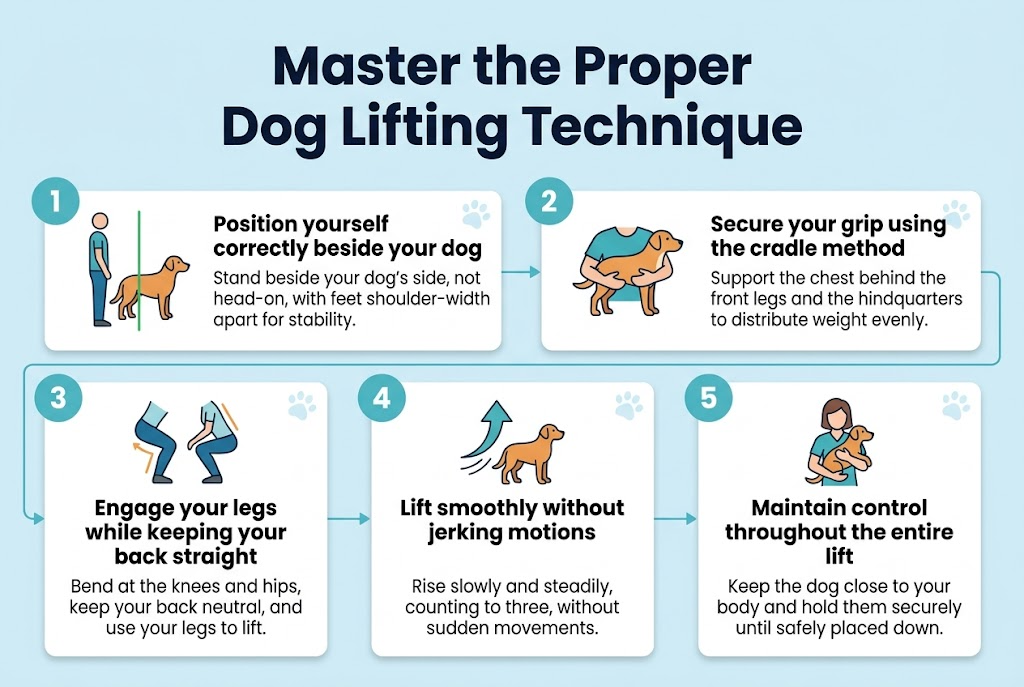
Create a clean professional infographic in a 3:2 aspect ratio, full-bleed layout with no border or inset frame. Use a bright veterinary-themed palette of soft blue, teal, white, and warm orange accents. Use modern sans-serif fonts with a bold title and clear section hierarchy.Top center: large bold heading in dark navy text, exactly: "Master the Proper Dog Lifting Technique"Below the title, arrange five wide horizontal sections across the page in a balanced two-row layout, with numbered step blocks and small illustrated icons. Each section should have a colored number circle, a simple icon, a short bold subheading, and one concise explanatory sentence. Use clean white cards with subtle shadows on a light blue background.Section 1 on the upper left:Number circle "1"Icon: a person standing beside a dog, side view, with a green alignment lineSubheading text: "Position yourself correctly beside your dog"Body text: "Stand beside your dog's side, not head-on, with feet shoulder-width apart for stability."Section 2 on the upper middle-right:Number circle "2"Icon: a cradle hold with arms supporting a dog under chest and hindquartersSubheading text: "Secure your grip using the cradle method"Body text: "Support the chest behind the front legs and the hindquarters to distribute weight evenly."Section 3 on the lower left:Number circle "3"Icon: bent knees, straight back, and a squat postureSubheading text: "Engage your legs while keeping your back straight"Body text: "Bend at the knees and hips, keep your back neutral, and use your legs to lift."Section 4 on the lower middle:Number circle "4"Icon: a smooth upward arrow with motion lines and a calm dogSubheading text: "Lift smoothly without jerking motions"Body text: "Rise slowly and steadily, counting to three, without sudden movements."Section 5 on the lower right:Number circle "5"Icon: a person holding a dog close against the torso with a secure gripSubheading text: "Maintain control throughout the entire lift"Body text: "Keep the dog close to your body and hold them securely until safely placed down."Add subtle paw-print accents and thin connector lines between sections for flow. Keep all text crisp, legible, and well spaced. Use a clean instructional infographic style with friendly dog-care visuals.

Position yourself correctly beside your dog

Stand next to your dog’s side rather than facing them head-on. This positioning gives you better leverage and control while keeping your spine aligned. Keep your feet shoulder-width apart for optimal stability and balance during the lift.

Secure your grip using the cradle method

Place one arm under your dog’s chest, supporting their ribcage just behind the front legs. Your other arm goes under their hindquarters, supporting their rear end and back legs. This cradle hold distributes their weight evenly across your arms and prevents strain on their limbs.

Engage your legs while keeping your back straight

Bend at your knees and hips, not your waist. Keep your back in its natural curve as you squat down to your dog’s level. Your leg muscles should do the heavy lifting work, protecting your spine from injury and giving you more power for the lift.

Lift smoothly without jerking motions

Rise slowly and steadily, using a controlled motion that keeps your dog calm and secure. Avoid sudden movements or quick jerks that could startle your pet or throw off your balance. Count to three as you lift to maintain a steady pace.

Maintain control throughout the entire lift

Keep your dog close to your body as you stand up completely. Hold them firmly but gently against your torso, ensuring they feel secure and supported. Maintain this controlled grip until you reach your destination or safely place them down.

Adapt Techniques for Different Dog Sizes
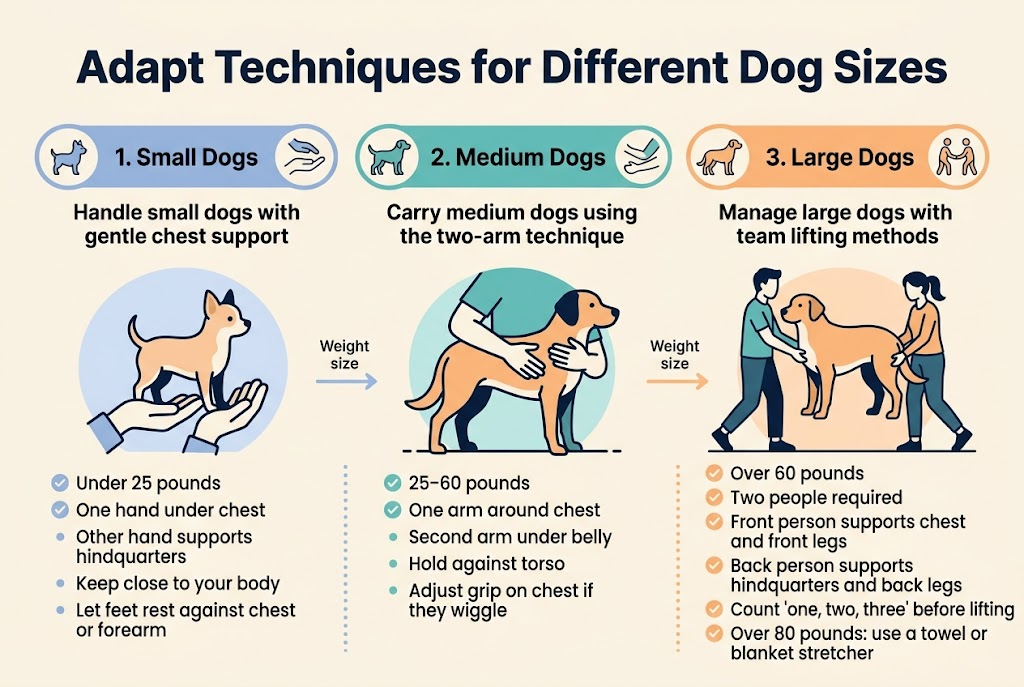
Create a clean professional infographic illustration in a 3:2 aspect ratio, full-bleed background, wide horizontal layout, no poster frame, no inset margins. Use a light cream background with navy, teal, and soft orange accents. Use bold sans-serif typography with strong hierarchy.Top center: large bold title in dark navy text, "Adapt Techniques for Different Dog Sizes".Below the title, arrange three wide horizontal sections across the page from left to right, each with a colored header bar, a simple icon, and a numbered label.LEFT SECTION:Header text: "1. Small Dogs"Subheader text: "Handle small dogs with gentle chest support"Include a small dog icon and a gentle hand-support icon.Place a small dog illustration above two hands supporting it.Add short bullet text:"โ€ข Under 25 pounds""โ€ข One hand under chest""โ€ข Other hand supports hindquarters""โ€ข Keep close to your body""โ€ข Let feet rest against chest or forearm"Use soft blue accents and rounded shapes.CENTER SECTION:Header text: "2. Medium Dogs"Subheader text: "Carry medium dogs using the two-arm technique"Include a medium dog icon and a two-arm support icon.Show one arm around the chest behind the front legs and the second arm under the belly near the back legs.Add short bullet text:"โ€ข 25โ€“60 pounds""โ€ข One arm around chest""โ€ข Second arm under belly""โ€ข Hold against torso""โ€ข Adjust grip on chest if they wiggle"Use teal accents and balanced, stable visual lines.RIGHT SECTION:Header text: "3. Large Dogs"Subheader text: "Manage large dogs with team lifting methods"Include a large dog icon and a two-person lifting icon.Show two people lifting a large dog together, one supporting the front end and one supporting the hindquarters.Add short bullet text:"โ€ข Over 60 pounds""โ€ข Two people required""โ€ข Front person supports chest and front legs""โ€ข Back person supports hindquarters and back legs""โ€ข Count 'one, two, three' before lifting""โ€ข Over 80 pounds: use a towel or blanket stretcher"Use orange accents and teamwork visuals.Add small visual markers next to each bullet point, such as check icons or dots. Include subtle arrows or weight-size labels linking the sections from small to medium to large. Keep the layout clean, spacious, modern, and highly readable. Use crisp vector-style illustrations, flat design, and clear contrast.

Handle small dogs with gentle chest support

Your approach with dogs under 25 pounds requires extra care since their delicate frames can’t handle rough handling. Place one hand under their chest, just behind the front legs, while your other hand supports their hindquarters. Keep them close to your body to prevent them from jumping or squirming out of your arms. Small dogs feel secure when their feet have something to rest against, so let them lean against your chest or forearm.

Also Read  10 Jaw-Dropping Dog Pool Ideas for Backyard Summer Fun!

Carry medium dogs using the two-arm technique

Dogs weighing 25-60 pounds need your full attention and both arms working together. Wrap one arm around their chest, positioning it behind their front legs for maximum support. Your second arm goes under their belly, close to their back legs. This distributes their weight evenly and gives you better control. Keep your back straight and hold them against your torso to maintain balance. If they start to wiggle, adjust your grip on their chest rather than squeezing tighter around their belly.

Manage large dogs with team lifting methods

Dogs over 60 pounds require two people for safe transport. One person takes the front end by supporting the chest and front legs, while the second person handles the back end, supporting the hindquarters and back legs. Coordinate your movements by counting “one, two, three” before lifting together. Move slowly and communicate throughout the process. For dogs over 80 pounds, consider using a large towel or blanket as a makeshift stretcher, with each person holding the corners to distribute the weight more evenly across your bodies.

Avoid Common Lifting Mistakes That Cause Injury
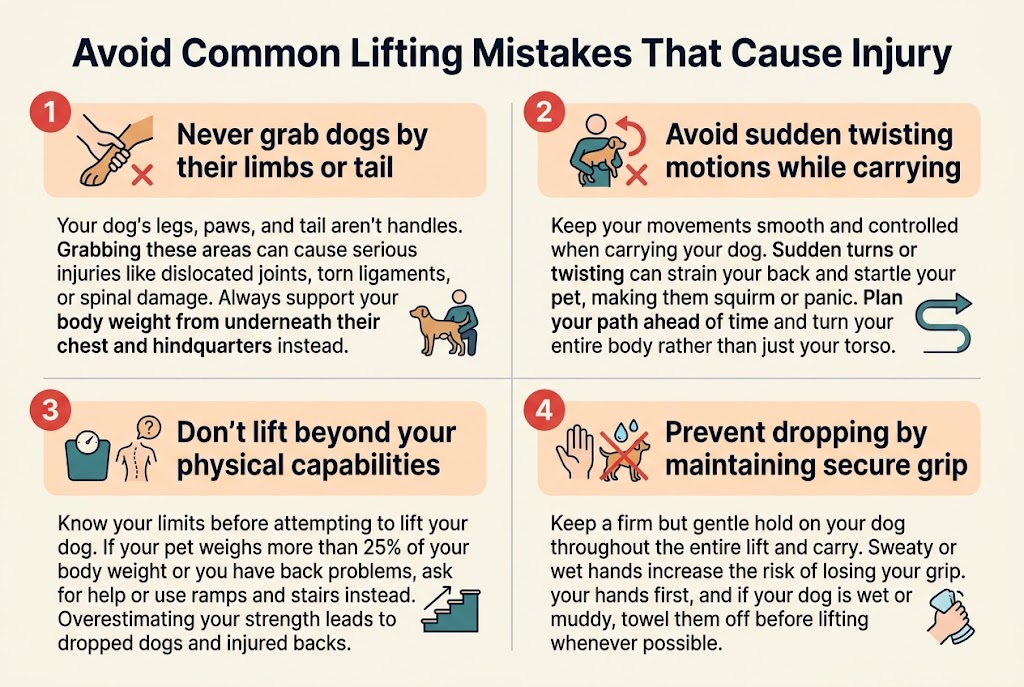
Create a clean professional full-bleed infographic in 3:2 landscape format with a light cream background, navy and teal accents, soft orange warning highlights, and modern sans-serif typography. Place a bold large title across the top center: "Avoid Common Lifting Mistakes That Cause Injury". Below the title, arrange four wide horizontal content blocks in a 2x2 grid with clear spacing and subtle dividers, each block with a numbered circle, a simple icon, a bold subheading, and short body text. Use rounded rectangles, crisp lines, and balanced whitespace. Top-left block: a red warning circle with number "1" and an icon of hands near a dog limb with a red X. Subheading text: "Never grab dogs by their limbs or tail". Body text: "Your dog's legs, paws, and tail aren't handles. Grabbing these areas can cause serious injuries like dislocated joints, torn ligaments, or spinal damage. Always support your dog's body weight from underneath their chest and hindquarters instead." Include a small visual of a person supporting a dog under the chest and hips.Top-right block: a red warning circle with number "2" and an icon of a person carrying a dog with a curved twisting arrow and red X. Subheading text: "Avoid sudden twisting motions while carrying". Body text: "Keep your movements smooth and controlled when carrying your dog. Sudden turns or twisting can strain your back and startle your pet, making them squirm or panic. Plan your path ahead of time and turn your entire body rather than just your torso." Include a simple pathway arrow.Bottom-left block: a red warning circle with number "3" and an icon of a scale, back silhouette, and help symbol. Subheading text: "Don't lift beyond your physical capabilities". Body text: "Know your limits before attempting to lift your dog. If your pet weighs more than 25% of your body weight or you have back problems, ask for help or use ramps and stairs instead. Overestimating your strength leads to dropped dogs and injured backs." Show a ramp or stairs icon beside it.Bottom-right block: a red warning circle with number "4" and an icon of a secure grip with dry hands and a dog with water droplets crossed out. Subheading text: "Prevent dropping by maintaining secure grip". Body text: "Keep a firm but gentle hold on your dog throughout the entire lift and carry. Sweaty or wet hands increase the risk of losing your grip. Dry your hands first, and if your dog is wet or muddy, towel them off before lifting whenever possible." Include a towel icon and a firm-hand grip symbol.Use dark navy text for headings, charcoal body text, and red/orange warning accents. Keep the layout wide, uncluttered, and easy to scan, with consistent icon style and clear hierarchy.

Never grab dogs by their limbs or tail

Your dog’s legs, paws, and tail aren’t handles. Grabbing these areas can cause serious injuries like dislocated joints, torn ligaments, or spinal damage. Always support your dog’s body weight from underneath their chest and hindquarters instead.

Avoid sudden twisting motions while carrying

Keep your movements smooth and controlled when carrying your dog. Sudden turns or twisting can strain your back and startle your pet, making them squirm or panic. Plan your path ahead of time and turn your entire body rather than just your torso.

Don’t lift beyond your physical capabilities

Know your limits before attempting to lift your dog. If your pet weighs more than 25% of your body weight or you have back problems, ask for help or use ramps and stairs instead. Overestimating your strength leads to dropped dogs and injured backs.

Prevent dropping by maintaining secure grip

Keep a firm but gentle hold on your dog throughout the entire lift and carry. Sweaty or wet hands increase the risk of losing your grip. Dry your hands first, and if your dog is wet or muddy, towel them off before lifting whenever possible.

You Might Also Like!

  • 10 Homemade Dog Food Recipes Every Dog Parent Should Know
  • Dog Kennel and Outdoor Dog House Layout Ideas: Stunning DIY Transformations
  • 10 backyard dog potty area ideas
    10 Genius Backyard Dog Potty Area Ideas That Stay Clean & Smell-Free
Rafay Khan

Post navigation

Previous Previous
How to Build a DIY Chain Link Dog Kennel Step by Step
NextContinue
How to Teach Your Dog to Clean Up Toys

You Might Also Like!

  • 10 Homemade Dog Food Recipes Every Dog Parent Should Know
  • Dog Kennel and Outdoor Dog House Layout Ideas: Stunning DIY Transformations
  • 10 backyard dog potty area ideas
    10 Genius Backyard Dog Potty Area Ideas That Stay Clean & Smell-Free

Search More!

About DearWorld

We share practical DIY tips, budget-friendly ideas, and creative inspiration for mobile homes, backyards, patios, porches, gardens, and skirting. Helping you make every space feel like home โ€” one project at a time.

  • About Us
  • Privacy Policy
  • Terms & Conditions
  • Blog

© 2026 Dear World - WordPress Theme by Kadence WP

Facebook Instagram Pinterest
Scroll to top
  • Home Improvement
    • Deck
    • Barn Doors
    • Patio
    • Bathroom
    • Garden Beds
    • Winter Home Prep
  • Mobile Home
    • Crawl Space
    • Skirting
  • Backyard
    • Landscaping
    • Curb Appeal
    • Water Features
  • Porch
  • Garden
  • Contact
Search