Skip to content

[email protected] | About Us |ย Privacy Policy | Terms Of Use

Facebook Pinterest
logo
  • Home ImprovementExpand
    • Deck
    • Barn Doors
    • Patio
    • Bathroom
    • Garden Beds
    • Winter Home Prep
  • Mobile HomeExpand
    • Crawl Space
    • Skirting
  • BackyardExpand
    • Landscaping
    • Curb Appeal
    • Water Features
  • Porch
  • Garden
  • Contact
logo
Pet Ideas

How to Teach Your Dog to Clean Up Toys

Teaching your dog to clean up toys transforms playtime chaos into an organized routine while strengthening your bond through positive training. This skill is perfect for dog owners who want a tidier home and enjoy working with their pets on fun, practical commands.

You’ll learn how to build the foundation with essential commands like “drop it” and “take it” that make cleanup training possible. We’ll walk through a simple step-by-step process that breaks down toy cleanup into manageable lessons your dog can master. You’ll also discover how to tackle common training roadblocks and maintain consistency so your dog reliably puts toys away on command.

Contents

Toggle
  • Essential Prerequisites for Toy Cleanup Training
      • Choose the right age to start training
      • Select appropriate toys for easy pickup
      • Establish a designated toy storage area
      • Gather necessary training treats and rewards
  • Master the Basic “Drop It” and “Take It” Commands
      • Teach your dog to pick up objects on command
      • Train reliable dropping and releasing behaviors
      • Practice with different toy types and textures
  • Step-by-Step Cleanup Training Process
      • Start with one toy and short training sessions
      • Use positive reinforcement for each successful pickup
      • Gradually increase the number of toys
      • Add the cleanup command to your dog’s vocabulary
      • Practice in different rooms and locations
  • Overcome Common Training Challenges
      • Address dogs who refuse to drop toys
      • Handle dogs who get distracted during cleanup
      • Manage dogs who play instead of cleaning
      • You Might Also Like!

Essential Prerequisites for Toy Cleanup Training

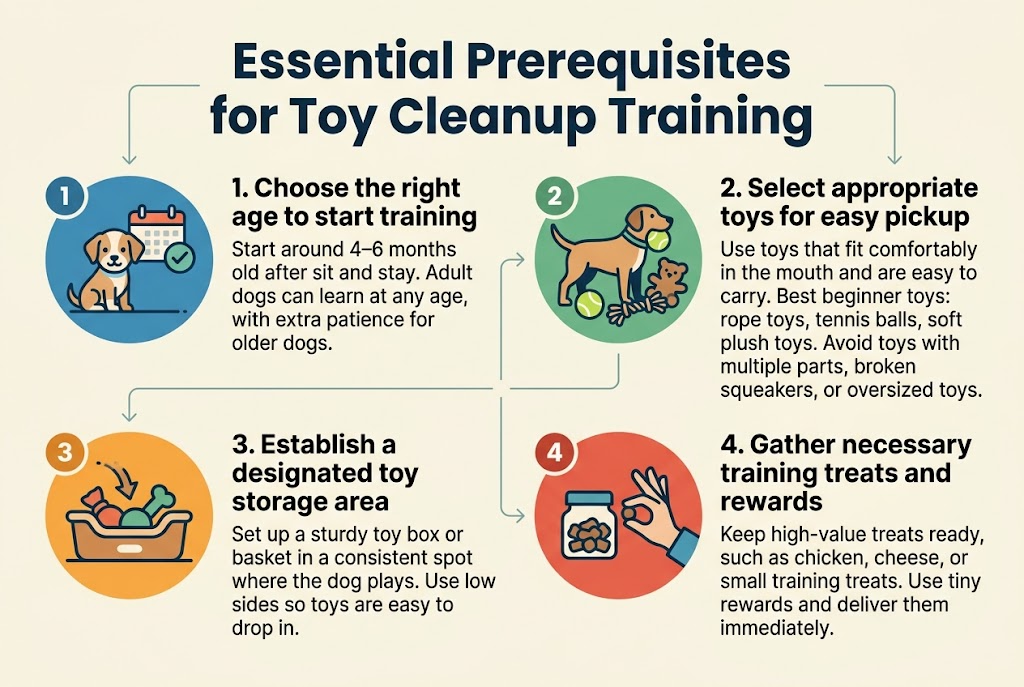
Create a clean, professional full-bleed infographic illustration in a 3:2 aspect ratio with a light cream background, teal and navy accents, warm orange highlights, and modern sans-serif typography. Place a bold, large heading across the top center: "Essential Prerequisites for Toy Cleanup Training". Use a wide horizontal layout with four clearly separated numbered sections arranged in a 2x2 grid across the center and lower area, with simple flat vector icons in each section.Section 1 on the upper left: a blue circular icon of a puppy beside a small calendar and a checkmark. Include the heading text: "1. Choose the right age to start training" and smaller body text: "Start around 4โ€“6 months old after sit and stay. Adult dogs can learn at any age, with extra patience for older dogs."Section 2 on the upper right: a green circular icon showing a dog carrying a tennis ball, rope toy, and plush toy. Include the heading text: "2. Select appropriate toys for easy pickup" and smaller body text: "Use toys that fit comfortably in the mouth and are easy to carry. Best beginner toys: rope toys, tennis balls, soft plush toys. Avoid toys with multiple parts, broken squeakers, or oversized toys."Section 3 on the lower left: an orange circular icon of a low toy basket or toy box at dog height with a toy being dropped in. Include the heading text: "3. Establish a designated toy storage area" and smaller body text: "Set up a sturdy toy box or basket in a consistent spot where the dog plays. Use low sides so toys are easy to drop in."Section 4 on the lower right: a red circular icon of training treats in a small container and a hand reward gesture. Include the heading text: "4. Gather necessary training treats and rewards" and smaller body text: "Keep high-value treats ready, such as chicken, cheese, or small training treats. Use tiny rewards and deliver them immediately."Add thin connecting lines or subtle arrows guiding the eye from the title to the four sections. Use clear iconography, high contrast text, generous spacing, and aligned edges. Include small numbered badges 1, 2, 3, 4 for each section. Make the design balanced, readable, and visually engaging with no extra text beyond the title and section copy.

Choose the right age to start training

Your puppy can begin learning basic toy cleanup skills around 4-6 months old, once they’ve mastered fundamental commands like sit and stay. Adult dogs can learn this trick at any age, though older dogs might need extra patience and shorter training sessions.

Select appropriate toys for easy pickup

Pick toys that fit comfortably in your dog’s mouth without being too heavy or awkward to carry. Rope toys, tennis balls, and soft plush toys work best for beginners. Avoid toys with multiple parts, squeakers that might break, or anything too large for your dog’s jaw size.

Also Read  8 Science-Backed Brain Games for a Calmer, Smarter Dog

Establish a designated toy storage area

Set up a specific toy box or basket that’s easily accessible and at your dog’s height level. Place it in a consistent location where your dog plays most often. The container should have low sides so your dog can drop toys in without difficulty, and make sure it’s sturdy enough to withstand daily use.

Gather necessary training treats and rewards

Stock up on high-value treats that your dog absolutely loves โ€“ think small pieces of cooked chicken, cheese, or commercial training treats. Keep rewards tiny so you won’t overfeed during multiple practice sessions. Have treats ready in your pocket or a nearby container so you can reward good behavior immediately when your dog drops a toy in the right spot.

Master the Basic “Drop It” and “Take It” Commands
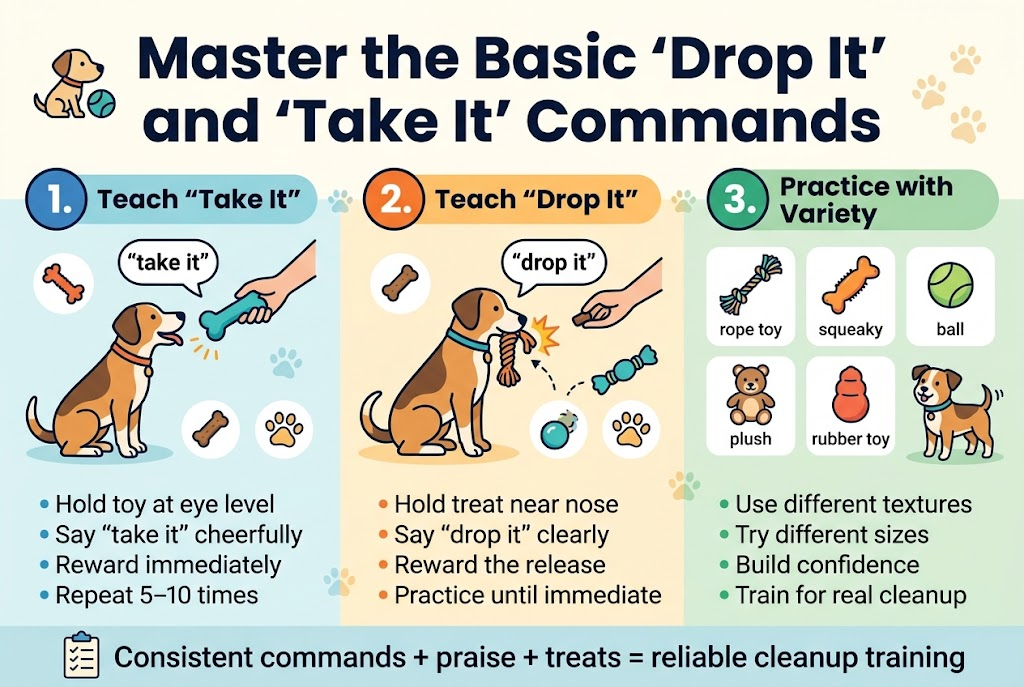
Create a clean professional pet-training infographic in a full-bleed 3:2 landscape layout with a bright friendly color palette of teal, orange, navy, white, and soft yellow. Use modern sans-serif fonts with a bold title at the top and clear section headers. Top header text: โ€œMaster the Basic โ€˜Drop Itโ€™ and โ€˜Take Itโ€™ Commandsโ€ in large bold navy lettering, with a small dog-and-toy icon beside it.Below the title, arrange three wide horizontal sections across the page in a 3-column layout with numbered badges and clear illustrations:LEFT SECTION, labeled โ€œ1. Teach โ€˜Take Itโ€™โ€, show a dog at eye level reaching for a favorite toy held by a hand. Include a cheerful speech bubble with the text โ€œtake itโ€. Add small visual icons for a toy, a treat, and praise. Include short bullet text: โ€œHold toy at eye levelโ€, โ€œSay โ€˜take itโ€™ cheerfullyโ€, โ€œReward immediatelyโ€, โ€œRepeat 5โ€“10 timesโ€. Use a blue circular number badge with โ€œ1โ€.CENTER SECTION, labeled โ€œ2. Teach โ€˜Drop Itโ€™โ€, show a dog holding a toy while a hand presents a treat near the nose. Include a speech bubble with the text โ€œdrop itโ€ and a reward burst near the released toy. Add icons for a treat, released toy, and praise. Include short bullet text: โ€œHold treat near noseโ€, โ€œSay โ€˜drop itโ€™ clearlyโ€, โ€œReward the releaseโ€, โ€œPractice until immediateโ€. Use an orange circular number badge with โ€œ2โ€.RIGHT SECTION, labeled โ€œ3. Practice with Varietyโ€, show five different toy icons arranged in a neat grid: rope toy, squeaky toy, ball, plush animal, and rubber toy. Include a small dog beside the toys with an encouraging pose. Add short bullet text: โ€œUse different texturesโ€, โ€œTry different sizesโ€, โ€œBuild confidenceโ€, โ€œTrain for real cleanupโ€. Use a green circular number badge with โ€œ3โ€.Add a thin bottom banner with a simple checklist icon and the text: โ€œConsistent commands + praise + treats = reliable cleanup trainingโ€. Use subtle paw-print accents and clean spacing, with each section separated by soft dividers. Keep all text crisp, readable, and exactly spelled as shown.

Teach your dog to pick up objects on command

Start with your dog’s favorite toy and hold it at their eye level. Say “take it” in a cheerful voice while gently moving the toy toward their mouth. When they grab it, immediately praise them with “good take it!” and offer a small treat. Repeat this process 5-10 times per session, always using the same command phrase. Your dog will quickly associate “take it” with picking up objects, creating the foundation for cleanup training.

Train reliable dropping and releasing behaviors

Once your dog masters picking up toys, teach them to release on command. Hold a treat close to their nose while they’re holding a toy and say “drop it” clearly. Most dogs will naturally drop the toy to investigate the treat. The moment they release it, say “good drop it!” and give them the reward. Practice this exchange repeatedly until your dog drops items immediately upon hearing the command, even without seeing a treat first.

Also Read  DIY Outdoor Pet Wash Station for Dogs and Cats

Practice with different toy types and textures

Expand your training beyond one favorite toy to include various textures, sizes, and materials. Use rope toys, squeaky toys, balls, plush animals, and rubber toys to build your dog’s confidence with different objects. Some dogs hesitate with certain textures initially, so be patient and encourage them with extra praise when they successfully pick up challenging items. This variety ensures your dog will clean up any toy type during actual cleanup sessions.

Step-by-Step Cleanup Training Process
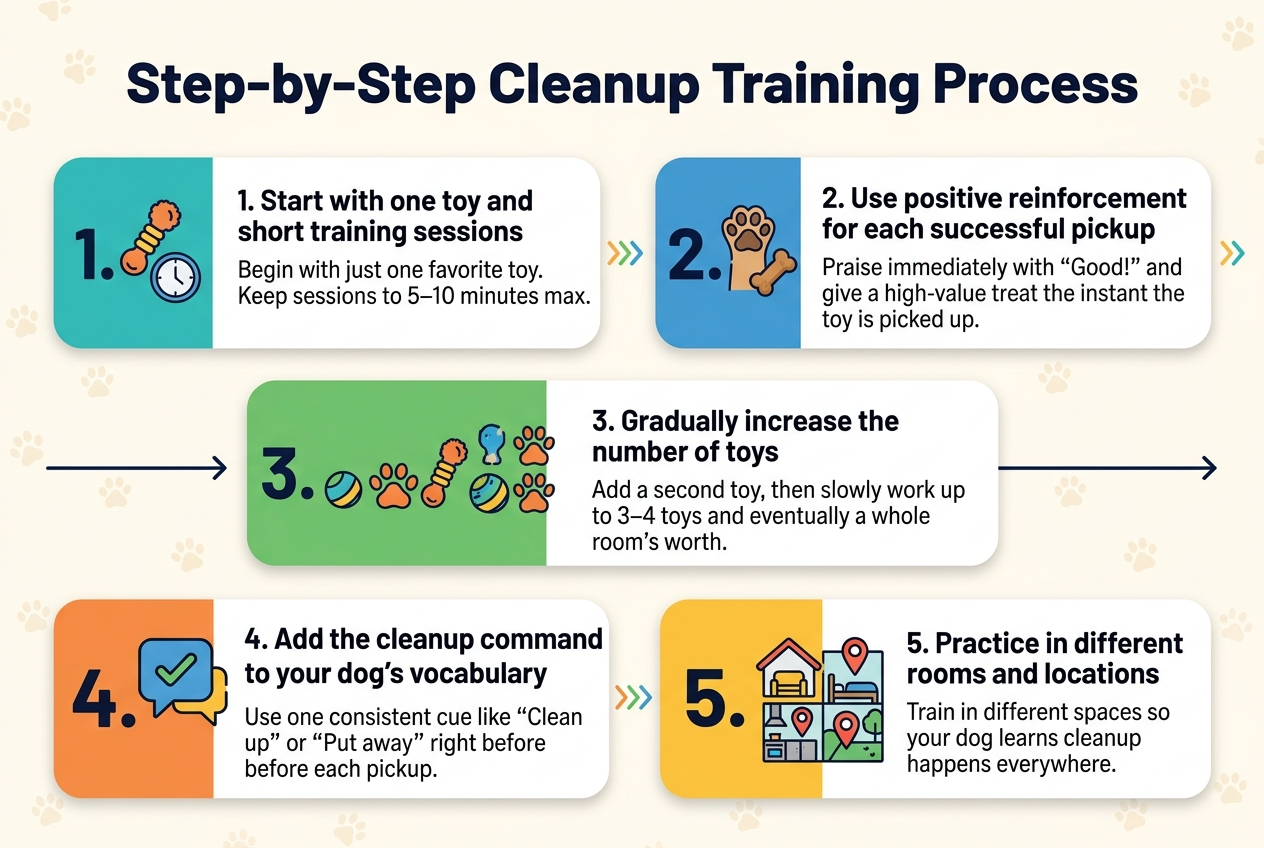
Create a clean professional infographic illustration in a 3:2 landscape full-bleed layout with a modern flat design, bright dog-friendly colors, and clear visual hierarchy. Use a bold dark navy headline at the top center: "Step-by-Step Cleanup Training Process". Place a subtle paw-print pattern in the background, with white/light cream canvas and accent colors of teal, blue, green, orange, and yellow.Arrange the content in five wide horizontal numbered sections across the page, using connected arrows or a left-to-right progression line. Each section should include a large number, a simple icon, a short bold subheading, and 1โ€“2 lines of body text. Use rounded rectangles with soft shadows and clean sans-serif typography.Section 1 on the far left: a toy icon and clock icon. Subheading text: "1. Start with one toy and short training sessions". Body text: "Begin with just one favorite toy. Keep sessions to 5โ€“10 minutes max."Section 2 next: a dog paw + treat icon. Subheading text: "2. Use positive reinforcement for each successful pickup". Body text: "Praise immediately with 'Good!' and give a high-value treat the instant the toy is picked up."Section 3 center: multiple toy icons increasing from one to four. Subheading text: "3. Gradually increase the number of toys". Body text: "Add a second toy, then slowly work up to 3โ€“4 toys and eventually a whole room's worth."Section 4 next: a speech bubble icon with a checkmark. Subheading text: "4. Add the cleanup command to your dog's vocabulary". Body text: "Use one consistent cue like 'Clean up' or 'Put away' right before each pickup."Section 5 on the far right: a home/room icon with location markers for living room, bedroom, kitchen, and backyard. Subheading text: "5. Practice in different rooms and locations". Body text: "Train in different spaces so your dog learns cleanup happens everywhere."Include small decorative arrows between sections, and use icons that are clear and friendly. Keep all text sharp and readable, aligned neatly inside each block. No people, no extra text, no borders outside the full-bleed composition.

Start with one toy and short training sessions

Begin your cleanup training with just one toy to keep things simple. Choose a favorite toy your dog already knows well. Keep your initial training sessions to 5-10 minutes max – dogs learn better with short, focused practice periods rather than long, overwhelming ones.

Use positive reinforcement for each successful pickup

Reward every small win during training. When your dog picks up the toy, immediately praise them with “Good!” and offer a high-value treat. Timing matters here – reward the instant they grab the toy, not after they’ve dropped it again. This builds a positive connection between toy pickup and good things happening.

Gradually increase the number of toys

Once your dog masters picking up one toy consistently, add a second toy to the mix. Don’t rush this step – wait until they’re comfortable before adding more. Slowly work up to 3-4 toys, then eventually a whole room’s worth. This gradual approach prevents your dog from feeling overwhelmed by too many choices.

Add the cleanup command to your dog’s vocabulary

Introduce a specific cleanup cue like “Clean up” or “Put away” once your dog understands the basic action. Say your chosen command right before they pick up each toy. Be consistent with your word choice – switching between different commands will confuse your dog and slow down their learning progress.

Also Read  Everyday Habits That Make Your Dog Happier

Practice in different rooms and locations

Your dog needs to learn that cleanup happens everywhere, not just in one spot. Start training in the living room, then move to the bedroom, kitchen, and backyard. This helps your dog understand that the cleanup rule applies no matter where they are. Change locations gradually so they can adapt to new environments while maintaining their skills.

Overcome Common Training Challenges
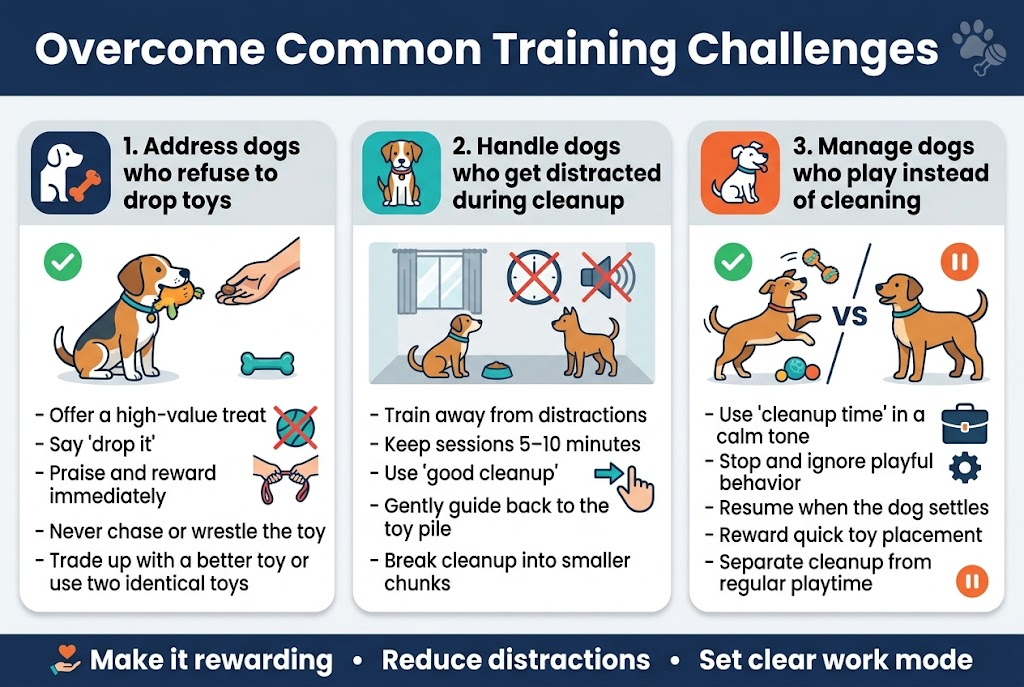
Create a clean professional infographic in a 3:2 aspect ratio, full-bleed layout with no frame and no large empty margins. Use a bright, friendly dog-training style with navy blue, teal, orange, and white, with light gray section backgrounds and bold accent icons. Use a modern sans-serif font, strong visual hierarchy, and wide horizontal sections rather than a vertical stack.Top header across the full width: large bold title text, centered or slightly left-aligned, reading "Overcome Common Training Challenges" with a subtle paw-print and toy icon beside it.Below the header, organize the content into three wide side-by-side or staggered horizontal sections with numbered labels and clear icons:1) Left section with a dog and toy icon, heading text: "1. Address dogs who refuse to drop toys"Include a small visual of a dog holding a squeaky toy and a hand offering a treat near the nose. Add short bullet-style text:- "Offer a high-value treat"- "Say 'drop it'"- "Praise and reward immediately"- "Never chase or wrestle the toy"- "Trade up with a better toy or use two identical toys"Use a green checkmark icon for the correct behaviors and a red crossed-out tug-of-war icon for the wrong behavior.2) Center section with a focused dog icon, heading text: "2. Handle dogs who get distracted during cleanup"Show a calm training area with no window distractions, no other pets, and minimal background noise symbols crossed out. Include short bullet-style text:- "Train away from distractions"- "Keep sessions 5โ€“10 minutes"- "Use 'good cleanup'"- "Gently guide back to the toy pile"- "Break cleanup into smaller chunks"Use a clock icon for session length and a directional hand/arrow icon for redirecting attention.3) Right section with a playful dog icon, heading text: "3. Manage dogs who play instead of cleaning"Show a dog playfully tossing toys versus a calm โ€œwork modeโ€ stance. Include short bullet-style text:- "Use 'cleanup time' in a calm tone"- "Stop and ignore playful behavior"- "Resume when the dog settles"- "Reward quick toy placement"- "Separate cleanup from regular playtime"Use a briefcase or gear icon for work mode and a small pause icon for stopping play.Add a bottom horizontal callout bar spanning the width with a simple three-step summary and small icons:"Make it rewarding" โ€ข "Reduce distractions" โ€ข "Set clear work mode"Keep all text crisp, legible, and exactly as written. Use rounded section cards, subtle shadows, and tidy spacing. No people, no realistic photography, no watermark.

Address dogs who refuse to drop toys

When your dog clamps down on that favorite squeaky toy and won’t let go, you need to make dropping more rewarding than holding. Start by offering a high-value treat right next to their nose while saying “drop it.” The moment they release the toy, praise enthusiastically and give the treat. Never chase or wrestle the toy away, as this turns cleanup into a fun game of tug-of-war. If treats aren’t working, try trading up with an even better toy or use two identical toys to keep the fun going while teaching the command.

Handle dogs who get distracted during cleanup

Distractible dogs need shorter training sessions and clearer boundaries. Set up your practice area away from windows, other pets, and household noise. Keep sessions to 5-10 minutes maximum before your dog’s attention wanes. Use verbal markers like “good cleanup” to redirect their focus back to the task when they start looking around. If your dog gets sidetracked mid-cleanup, gently guide them back to the toy pile with an enthusiastic voice and pointing gesture. Breaking the cleanup into smaller chunks helps maintain focus better than expecting them to clean everything at once.

Manage dogs who play instead of cleaning

Playful dogs see toy cleanup as party time, but you can redirect that energy productively. Establish a clear “work mode” by using a specific command like “cleanup time” in a calm, businesslike tone rather than your excited play voice. When your dog starts playing with toys instead of putting them away, immediately stop the session and ignore the playful behavior. Resume only when they settle down. Reward quick, efficient toy placement with brief praise, then move to the next toy before play mode kicks in. Keep cleanup sessions separate from regular playtime to help your dog understand the difference.

You Might Also Like!

  • 10 backyard dog potty area ideas
    10 Genius Backyard Dog Potty Area Ideas That Stay Clean & Smell-Free
  • 10 Homemade Dog Food Recipes Every Dog Parent Should Know
  • Dog Kennel and Outdoor Dog House Layout Ideas: Stunning DIY Transformations
Rafay Khan

Post navigation

Previous Previous
How to Carry Your Dog Safely (Proper Lifting Techniques)
NextContinue
Essential Dog Training Commands Every Owner Should Teach

You Might Also Like!

  • 10 backyard dog potty area ideas
    10 Genius Backyard Dog Potty Area Ideas That Stay Clean & Smell-Free
  • 10 Homemade Dog Food Recipes Every Dog Parent Should Know
  • Dog Kennel and Outdoor Dog House Layout Ideas: Stunning DIY Transformations

Search More!

About DearWorld

We share practical DIY tips, budget-friendly ideas, and creative inspiration for mobile homes, backyards, patios, porches, gardens, and skirting. Helping you make every space feel like home โ€” one project at a time.

  • About Us
  • Privacy Policy
  • Terms & Conditions
  • Blog

© 2026 Dear World - WordPress Theme by Kadence WP

Facebook Instagram Pinterest
Scroll to top
  • Home Improvement
    • Deck
    • Barn Doors
    • Patio
    • Bathroom
    • Garden Beds
    • Winter Home Prep
  • Mobile Home
    • Crawl Space
    • Skirting
  • Backyard
    • Landscaping
    • Curb Appeal
    • Water Features
  • Porch
  • Garden
  • Contact
Search