Skip to content

[email protected] | About Us |ย Privacy Policy | Terms Of Use

Facebook Pinterest
logo
  • Home ImprovementExpand
    • Deck
    • Barn Doors
    • Patio
    • Bathroom
    • Garden Beds
    • Winter Home Prep
  • Mobile HomeExpand
    • Crawl Space
    • Skirting
  • BackyardExpand
    • Landscaping
    • Curb Appeal
    • Water Features
  • Porch
  • Garden
  • Contact
logo
Pet Ideas

8 Science-Backed Brain Games for a Calmer, Smarter Dog

Your dog’s restless behavior, destructive chewing, or constant barking might signal something simple: a bored brain craving stimulation. Smart, mentally engaged dogs are calmer, happier, and easier to live with.

This guide is for dog owners who want to tap into their pet’s natural intelligence while building a stronger bond. You’ll discover science-backed brain games that work for dogs of all ages and energy levels.

We’ll explore puzzle feeding games that turn mealtime into mental workouts and scent work activities that engage your dog’s most powerful sense. You’ll also learn how to create calming brain games specifically designed for anxious or hyperactive dogs, plus simple memory exercises that strengthen your connection while sharpening their focus.

Contents

Toggle
  • Understanding Your Dog’s Mental Stimulation Needs
      • Signs your dog needs more cognitive challenges
      • How mental exercise reduces anxiety and destructive behaviors
      • The connection between brain training and improved obedience
  • Puzzle Feeding Games That Enhance Problem-Solving Skills
      • Interactive treat-dispensing toys for sustained engagement
      • DIY puzzle feeders using household items
      • Progressive difficulty levels to maintain interest
  • Scent Work Activities for Natural Canine Intelligence
      • Hide and seek games with favorite toys or treats
      • Teaching your dog to find specific scented objects
      • Building confidence through successful scent detection
  • Memory and Focus Training Through Simple Commands
      • The “Stay” Game Variations for Impulse Control
      • Teaching Your Dog to Remember Sequences of Actions
      • Using Hand Signals to Improve Visual Attention
  • Social Intelligence Games for Better Human-Dog Bonding
      • Turn-taking exercises that build patience
      • Eye contact games that strengthen communication
      • Cooperative play activities that require teamwork
      • You Might Also Like!

Understanding Your Dog’s Mental Stimulation Needs

Create a clean, professional full-bleed infographic in a 3:2 aspect ratio about dog behavior and mental stimulation. Use a modern veterinary-style design with a light cream background, teal, blue, and warm orange accents, bold sans-serif fonts, clear hierarchy, and wide horizontal sections instead of a vertical poster layout.Top header across the full width:Large bold title in dark navy: "Understanding Your Dog's Mental Stimulation Needs"Small subtitle underneath in medium gray: "How brain games support calmer behavior and better obedience"Main body arranged in three wide horizontal panels or three side-by-side sections with numbered circles and icons.Section 1 on the left:Heading in bold teal: "1. Signs your dog needs more cognitive challenges"Include a cluster of small dog icons with warning symbols and labeled visual cues:- "Excessive barking" with a barking dog icon- "Destructive chewing" with a chewed shoe or furniture icon- "Digging" with a digging dog icon- "Restless pacing" with a looping walking path icon- "Tail chasing" with a circular motion icon- "Obsessive licking" with a licking dog icon- "Bored on walks" with a leash and dull expression icon- "Mischief" with trash can and escape hatch iconsUse short supporting text in a clean text box: "Physical exercise is not enough when these behaviors continue."Section 2 in the center:Heading in bold blue: "2. Mental exercise reduces anxiety and destructive behaviors"Show a calm dog with a puzzle feeder or brain game toy, surrounded by soft glow lines, a peace symbol, and small feel-good spark icons.Include three short text blocks or callouts:- "Natural anxiety reliever"- "Calmness and satisfaction"- "Less chewing, barking, and stress"Add a small brain icon and a paw icon connected by a smooth line.Use a gentle wave graphic or balanced energy meter to suggest stress turning into calm.Section 3 on the right:Heading in bold orange: "3. Brain training improves obedience"Show a focused dog sitting attentively beside a trainer hand signal, with a checklist, target icon, and reward treat icon.Include three short callouts:- "Better focus"- "Stronger impulse control"- "Improved response to commands"Add a simple arrow sequence showing "Think โ†’ Wait โ†’ Reward"Use a checkmark icon and a training whistle icon.Bottom strip across the full width:A concise concluding banner in dark navy with white text: "Mental stimulation builds confidence, self-regulation, and better behavior"Add small supporting icons along the bottom: brain, puzzle toy, checkmark, calm dog silhouette.Style details:Flat vector illustration, crisp lines, soft shadows, balanced spacing, strong visual hierarchy, no photo realism, no clutter, no narrow centered stack, readable infographic text, polished editorial layout.

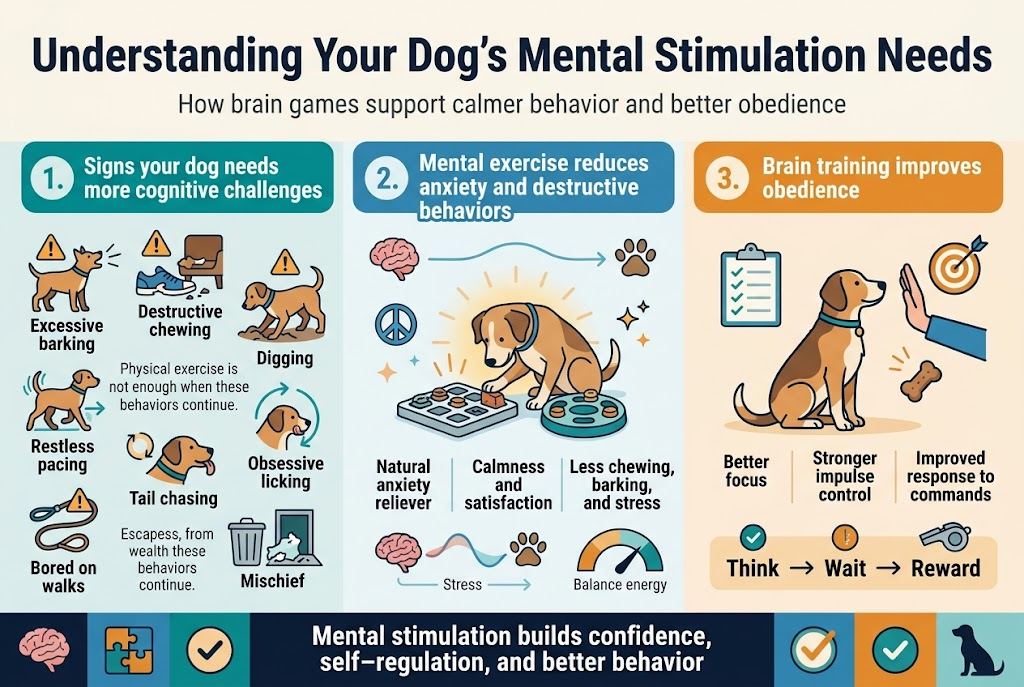
Signs your dog needs more cognitive challenges

Your dog might be sending clear signals that their brain needs a workout. Watch for excessive barking, destructive chewing, digging, or restless pacing around the house. Dogs who are mentally understimulated often develop repetitive behaviors like tail chasing or obsessive licking. You’ll also notice if your pup seems bored during walks, lacks enthusiasm for their usual activities, or becomes overly excited by minor stimuli. Some dogs will even create their own “entertainment” by getting into mischief, raiding trash cans, or finding creative ways to escape. When your dog’s physical exercise needs are met but they’re still displaying these behaviors, it’s time to challenge their mind.

Also Read  DIY Outdoor Pet Wash Station for Dogs and Cats

How mental exercise reduces anxiety and destructive behaviors

Mental stimulation works like a natural anxiety reliever for your dog’s brain. When you engage your dog in cognitive activities, their brain releases feel-good chemicals that promote calmness and satisfaction. Think of it as meditation for dogs – focused mental work helps them process stress and channel nervous energy productively. Dogs who regularly engage in brain games show significantly less destructive behavior because they’re using their mental energy constructively rather than finding outlets through chewing furniture or excessive barking. The concentration required for puzzle-solving also teaches your dog to self-regulate, building their confidence and emotional stability over time.

The connection between brain training and improved obedience

Brain training creates a foundation for better obedience by strengthening your dog’s ability to focus and process information. When you regularly challenge your dog’s mind, you’re essentially building their attention span and teaching them that thinking before acting leads to rewards. This mental discipline naturally carries over into training sessions, making your dog more receptive to learning new commands and following instructions. Dogs who participate in regular cognitive exercises develop stronger impulse control, which means they’re less likely to react impulsively and more likely to wait for your cues. The problem-solving skills they gain from brain games also help them understand what you’re asking for during obedience training.

Puzzle Feeding Games That Enhance Problem-Solving Skills
Create a full-bleed 3:2 horizontal infographic with a clean professional flat-vector style, bright pet-friendly colors (teal, orange, yellow, navy, white), modern sans-serif fonts, subtle shadows, and clear visual hierarchy.Top banner across the full width with a bold headline in large dark navy text: "Puzzle Feeding Games That Enhance Problem-Solving Skills". Add a small subtitle beneath in smaller teal text: "Interactive treat-dispensing toys for sustained engagement".Below the title, divide the layout into three wide horizontal sections or three side-by-side panels with rounded boxes and distinct color accents.Left panel: "1. Treat-Dispensing Toys"Include three illustrated dog puzzle toys with small treat icons:- a Kong toy stuffed with kibble- a rolling puzzle ball releasing treats- a rotating treat dispenserAdd a clock icon and a text callout: "15โ€“30 minutes of engagement"Add a small brain icon and a text callout: "Builds problem-solving skills"Add a slider/difficulty icon and text: "Adjustable difficulty"Center panel: "2. DIY Puzzle Feeders"Show four household-item illustrations with labels:- empty toilet paper roll with folded ends- muffin tin with tennis balls covering treats- ice cube tray with frozen wet food- rolled towel with treats hidden insideAdd a money-saving icon and text: "Affordable and creative"Add a paw-print icon beside each item labelRight panel: "3. Progressive Difficulty Levels"Show a simple progression graphic from left to right:- easy treat container- medium multi-step puzzle- hard sequence puzzleAdd a small progress arrow between each stageInclude these text callouts:"Start simple""Increase challenge gradually""Switch puzzle types weekly""Under 2 minutes = level up"Add a small calendar icon next to "Switch puzzle types weekly" and a stopwatch icon next to "Under 2 minutes = level up"Use clear numbered markers "1", "2", "3" at the top of each panel. Include dog-themed decorative icons like paw prints, treats, and puzzle pieces in the background. Keep all text large, readable, and well spaced, with the sections aligned horizontally across the canvas.

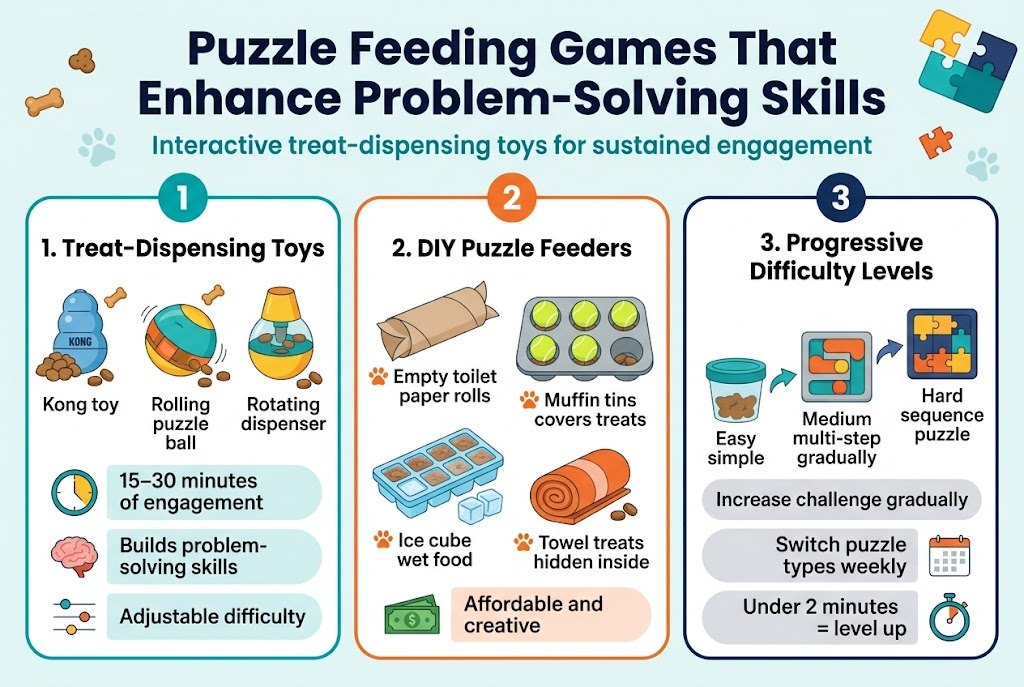
Interactive treat-dispensing toys for sustained engagement

Start your puzzle feeding journey with treat-dispensing toys that make your dog work for their food. Kong toys stuffed with kibble, puzzle balls that release treats as they roll, and rotating treat dispensers turn mealtime into a brain workout. These toys keep your dog engaged for 15-30 minutes, preventing boredom while building problem-solving skills. Look for toys with adjustable difficulty settings so you can increase the challenge as your dog masters each level.

DIY puzzle feeders using household items

Transform everyday items into brain-stimulating feeders without spending extra money. Hide kibble in empty toilet paper rolls with the ends folded shut, scatter treats inside a muffin tin covered with tennis balls, or freeze wet food in ice cube trays for a challenging lick puzzle. Old towels work great too – simply sprinkle treats throughout and roll up the towel for a sniffing and unraveling challenge. These homemade options give you endless creativity while saving your wallet.

Also Read  10 Jaw-Dropping Dog Pool Ideas for Backyard Summer Fun!

Progressive difficulty levels to maintain interest

Keep your dog mentally sharp by gradually increasing puzzle complexity over time. Begin with simple treat-filled containers that require minimal effort, then progress to multi-step puzzles requiring specific movements or sequences. Track your dog’s success rate – when they solve puzzles in under two minutes consistently, it’s time to level up. Rotate between different puzzle types weekly to prevent your dog from getting bored with the same challenges. This progression ensures continuous mental growth and sustained engagement.

Scent Work Activities for Natural Canine Intelligence
Create a clean professional infographic illustration in a 3:2 aspect ratio, full-bleed layout with no poster frame, using a wide horizontal composition. Use a modern sans-serif font with strong hierarchy, dark navy text on a light cream background, with accents in teal, warm orange, and green.Top center: large bold heading text: โ€œScent Work Activities for Natural Canine Intelligenceโ€Below the title, arrange three wide horizontal sections across the page or in a 3-column layout with clear spacing, each section with a colored header bar, a numbered circle icon, and a simple flat illustration.Section 1 on the left:Numbered circle โ€œ1โ€ with a paw print icon.Header text: โ€œHide and Seek Gamesโ€Subtext bullets:โ€œHide favorite toys or high-value treatsโ€โ€œStart behind furniture, under blankets, or in open boxesโ€โ€œLet your dog watch at first, then hide when they are not lookingโ€โ€œIncrease difficulty with multiple rooms and different heightsโ€Include a cartoon dog sniffing near a couch, blanket, and open box, with a toy and treat icons.Section 2 in the center:Numbered circle โ€œ2โ€ with a nose or scent swirl icon.Header text: โ€œFind the Correct Scentโ€Subtext bullets:โ€œUse cotton balls dabbed with lavender or vanillaโ€โ€œLet your dog sniff the target scentโ€โ€œHide the scented object among unscented itemsโ€โ€œReward only when the correct scent is foundโ€Include small cotton balls, scent labels, and a dog nose tracking a trail between several objects.Section 3 on the right:Numbered circle โ€œ3โ€ with a star and shield icon.Header text: โ€œBuild Confidenceโ€Subtext bullets:โ€œStart with obvious hiding spots and strong scentsโ€โ€œCelebrate every successโ€โ€œGuide your dog closer if they get stuckโ€โ€œRepeat positive experiences for eager learningโ€Include a happy dog with a glowing checkmark, treat reward, and encouraging sparkles.Add a slim bottom banner spanning the width with the concluding text:โ€œPositive scent work builds tracking instincts, mental stimulation, and confidenceโ€Use subtle connecting arrows or flow lines from Section 1 to Section 2 to Section 3 to show progression from easy to advanced. Keep the layout airy, balanced, and visually organized, with crisp icons, simple dog illustrations, and clear readable text.

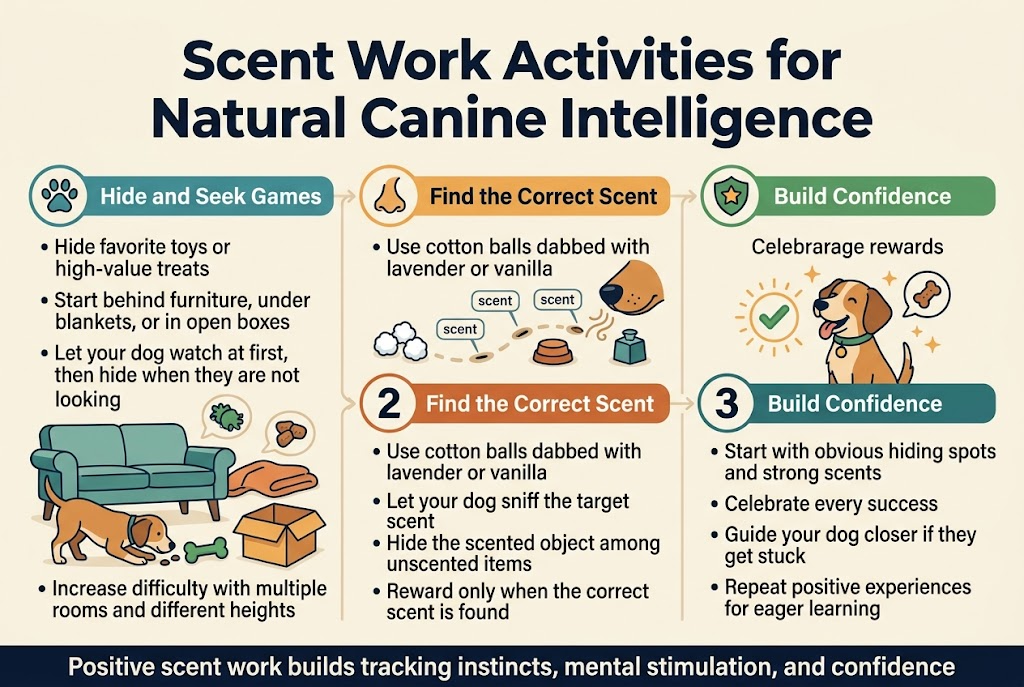
Hide and seek games with favorite toys or treats

Start with simple hiding spots around your home – behind furniture, under blankets, or in open boxes. Place your dog’s favorite toy or high-value treat in these locations while they watch, then encourage them to “find it.” Gradually increase difficulty by hiding items when your dog isn’t looking, using multiple rooms, or placing treats at different heights. This builds their natural tracking instincts while providing mental stimulation.

Teaching your dog to find specific scented objects

Introduce scent discrimination by using cotton balls dabbed with different essential oils like lavender or vanilla. Begin by letting your dog sniff the target scent, then hide that specific scented object among several unscented items. Reward them only when they locate the correct scent. Progress to using multiple different scents, teaching them to find only the one you’ve designated. This advanced skill taps into their incredible olfactory abilities.

Building confidence through successful scent detection

Design your scent games to guarantee early wins – start with obvious hiding spots and strong scents before advancing to challenging scenarios. Celebrate every success enthusiastically, even small ones. When your dog struggles, guide them closer to the target rather than letting them get frustrated. Regular positive experiences with scent work create confident, eager learners who approach new challenges with enthusiasm rather than anxiety.

Memory and Focus Training Through Simple Commands
Create a clean professional full-bleed infographic illustration in 3:2 aspect ratio with a modern flat vector style, soft shadows, and a blue-green-orange color palette on a light off-white background.Top header across the full width: large bold title text, "Memory and Focus Training Through Simple Commands" with a smaller subtitle beneath it, "The 'Stay' Game Variations for Impulse Control". Add a subtle dog silhouette or paw-print motif behind the header.Below the header, arrange three wide horizontal sections in a 3-column layout from left to right, each in a rounded rectangle card with a bold numbered circle icon.LEFT CARD: blue theme, icon of a dog sitting with a stop hand symbol and a doorbell icon.Heading text: "1. Stay Game Variations"Body text in short lines:"Start with basic stays""Move around the room""Add distractions: drop treats nearby""Advance to doorbell rings and guests arriving"Small caption strip at bottom: "Builds impulse control and mental discipline"CENTER CARD: green theme, icon of a sequence path with paw prints and checkmarks.Heading text: "2. Remember Sequences of Actions"Body text in short lines:"Begin with two-step chains: 'sit, then shake'""Add a third command: 'sit, shake, then lie down'""Practice daily in the same order initially"Small caption strip at bottom: "Strengthens working memory"RIGHT CARD: orange theme, icon of a dog facing a hand signal with eye focus lines.Heading text: "3. Hand Signals for Visual Attention"Body text in short lines:"Replace verbal commands with hand signals""Use simple gestures for 'sit' and 'down'""Maintain eye contact""Practice in different lighting and distances"Small caption strip at bottom: "Improves visual focus and body-language reading"Add a slim bottom band spanning the full width with three small icon callouts and labels:"Impulse Control""Working Memory""Visual Attention"Use bold sans-serif fonts for headings, smaller readable sans-serif for body text, strong contrast, clean spacing, and clear hierarchy. Include simple dog training visuals, arrows, checkmarks, treats, doorbell, hand gesture, and eye focus symbols. Keep all text crisp and legible.

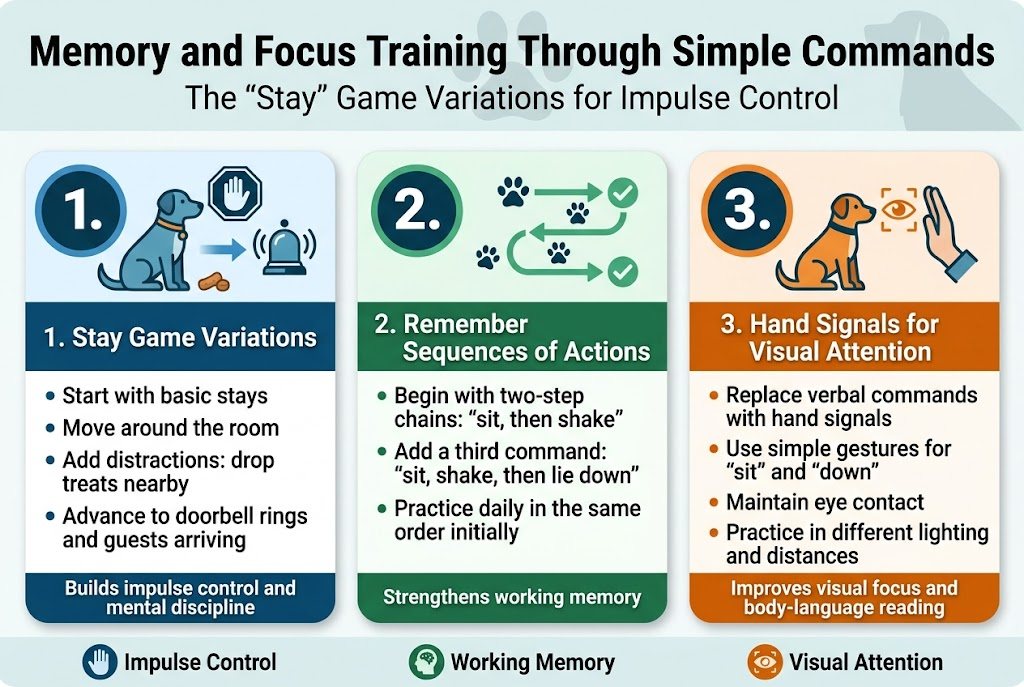
The “Stay” Game Variations for Impulse Control

Start with basic stays and gradually increase difficulty. Have your dog stay while you move around the room, then add distractions like dropping treats nearby. Progress to “stay” during doorbell rings or when guests arrive. These variations teach your dog to resist immediate impulses and think before acting, building mental discipline that transfers to other behaviors.

Also Read  Dog Kennel Shed Interior Ideas for Comfortable Outdoor Living: 10 Stunning Transformations

Teaching Your Dog to Remember Sequences of Actions

Begin with two-step sequences like “sit, then shake” before rewarding. Once mastered, add a third command like “sit, shake, then lie down.” Practice these chains daily, always in the same order initially. Your dog’s working memory strengthens as they learn to hold multiple instructions in mind. This mental exercise mimics the cognitive demands of real-world situations where dogs must remember and execute complex behaviors.

Using Hand Signals to Improve Visual Attention

Replace verbal commands with hand signals to sharpen your dog’s visual focus. Start with simple gestures for “sit” or “down” while maintaining eye contact. Practice in different lighting conditions and distances to challenge their attention span. Hand signals force your dog to watch you carefully rather than just listening passively. This visual engagement creates stronger neural pathways and improves their ability to read human body language and facial expressions.

Social Intelligence Games for Better Human-Dog Bonding
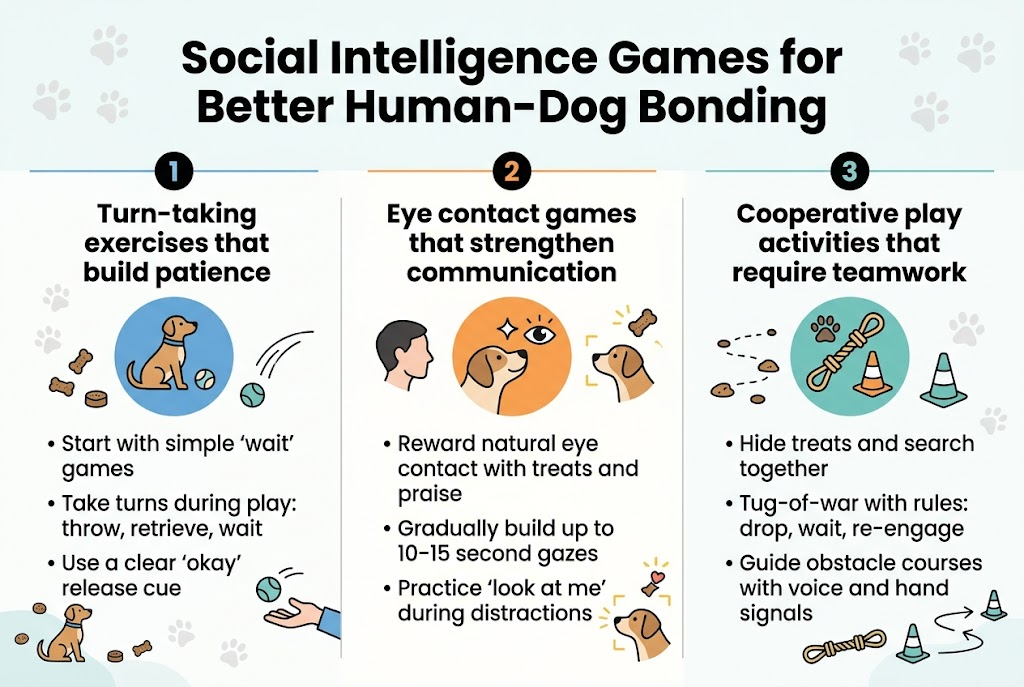
Create a clean, professional full-bleed infographic in 3:2 aspect ratio with a bright, friendly pet-training style. Use a wide horizontal layout with three equal columns or three large stacked horizontal panels across the page, not a narrow vertical poster. Color palette: soft teal, warm orange, light blue, white, charcoal text, with subtle yellow accent highlights. Use modern sans-serif fonts with a bold headline and clear section headers.Top center large bold title text: "Social Intelligence Games for Better Human-Dog Bonding"Below the title, divide the infographic into 3 clearly separated sections with numbered circles and matching icons:1) Left section, header in bold: "Turn-taking exercises that build patience"Add a blue circular icon with a dog sitting beside a treat and a small ball.Include 3 short bullet lines:"โ€ข Start with simple 'wait' games""โ€ข Take turns during play: throw, retrieve, wait""โ€ข Use a clear 'okay' release cue"Add small visual elements of treats placed around a sitting dog and a hand tossing a ball.2) Center section, header in bold: "Eye contact games that strengthen communication"Add an orange circular icon with a dog face looking up at a personโ€™s eyes and a spark or heart symbol.Include 3 short bullet lines:"โ€ข Reward natural eye contact with treats and praise""โ€ข Gradually build up to 10โ€“15 second gazes""โ€ข Practice 'look at me' during distractions"Add small visual elements of a person face silhouette and a dog making eye contact, with focus lines and treat icons.3) Right section, header in bold: "Cooperative play activities that require teamwork"Add a teal circular icon with a tug toy, paw print, and obstacle cone.Include 3 short bullet lines:"โ€ข Hide treats and search together""โ€ข Tug-of-war with rules: drop, wait, re-engage""โ€ข Guide obstacle courses with voice and hand signals"Add small visual elements of a hide-and-seek treat trail, tug rope, and a simple obstacle course with cones and arrows.Use bold numbered markers 1, 2, 3 at the top of each section. Add thin divider lines between sections. Keep text large, readable, and neatly aligned. Use a balanced infographic composition with plenty of white space, clean icons, and subtle paw-print accents in the background.

Turn-taking exercises that build patience

Start with simple “wait” games where your dog sits while you place treats around them, only releasing them with a clear “okay” command. Practice taking turns during play sessions – you throw the ball, they bring it back, then they wait for your signal before the next throw. These exercises teach your dog that good things come to those who wait, building impulse control while strengthening your leadership bond. Try alternating who initiates play activities to create a balanced give-and-take relationship.

Eye contact games that strengthen communication

Build meaningful connections through sustained eye contact exercises. Begin by rewarding your dog with treats and praise whenever they naturally look at your face. Gradually extend the duration, working up to 10-15 second gazes. Practice the “look at me” command during distractions to enhance focus and attention. These games create deeper emotional bonds while improving your dog’s ability to read your facial expressions and body language, making training sessions more effective and communication clearer.

Cooperative play activities that require teamwork

Design activities where you and your dog work together toward a common goal. Hide treats around the house and search for them as a team, with you providing verbal clues and encouragement. Try tug-of-war games with specific rules – your dog must drop the toy when asked, then wait for permission to re-engage. Set up obstacle courses where you guide them through challenges using only voice commands and hand signals, creating trust and cooperation while exercising both mind and body together.

You Might Also Like!

  • 5 Easy DIY Dog Enrichment Games You Can Make at Home
  • Everyday Habits That Make Your Dog Happier
  • 10 Homemade Dog Food Recipes Every Dog Parent Should Know
Rafay Khan

Post navigation

Previous Previous
5 Easy DIY Dog Enrichment Games You Can Make at Home
NextContinue
8 Fresh No-Bake Dog Treat Recipes You Can Make Anytime

You Might Also Like!

  • 5 Easy DIY Dog Enrichment Games You Can Make at Home
  • Everyday Habits That Make Your Dog Happier
  • 10 Homemade Dog Food Recipes Every Dog Parent Should Know

Search More!

About DearWorld

We share practical DIY tips, budget-friendly ideas, and creative inspiration for mobile homes, backyards, patios, porches, gardens, and skirting. Helping you make every space feel like home โ€” one project at a time.

  • About Us
  • Privacy Policy
  • Terms & Conditions
  • Blog

© 2026 Dear World - WordPress Theme by Kadence WP

Facebook Instagram Pinterest
Scroll to top
  • Home Improvement
    • Deck
    • Barn Doors
    • Patio
    • Bathroom
    • Garden Beds
    • Winter Home Prep
  • Mobile Home
    • Crawl Space
    • Skirting
  • Backyard
    • Landscaping
    • Curb Appeal
    • Water Features
  • Porch
  • Garden
  • Contact
Search